耶 (yē/yé) means "(phonetic) Jesus; yeah" in Chinese. It has 8 strokes with the radical 耳.
Rated 3.7/5 in difficulty (challenging).
Appears in 3+ common words including 耶稣 (yē sū), 耶鲁 (yé lǔ), 耶和华 (yē hé huá).
Due to its 8 strokes, Hanzi Writer's error detection shows 耶 requires focused practice — most learners need 10+ attempts for consistent accuracy.
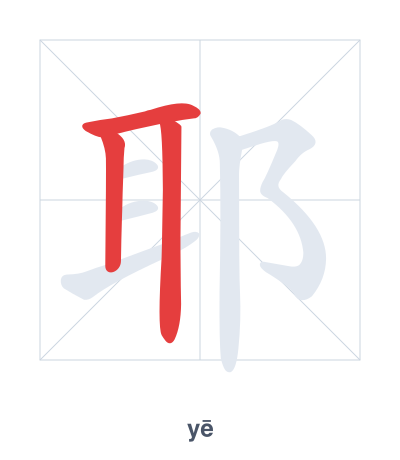
Open Hanzi Writer to see the animated stroke order and practice writing 耶 with real-time feedback.
The character 耶 (yē/yé) is written with 8 strokes. Follow the standard Chinese stroke order: top to bottom, left to right, outside before inside. The radical 耳 is one of its key components.
Practice the correct stroke order with the Hanzi Writer app to see animated stroke-by-stroke guidance with real-time feedback.
耶 means (phonetic) Jesus; yeah.
This is a polyphonic character with readings: yē, yé.
| Character | 耶 |
| Pinyin | yē / yé (ye) |
| Meaning | (phonetic) Jesus; yeah |
| Strokes | 8 |
| Radical | 耳 |
| Difficulty | 3.7/5 |
耶 is a phonetic loan character, originally used as a classical Chinese particle. It combines the radical 耳 (ear) with the component 阝 (a form of 邑, meaning city), but these elements do not directly convey its modern meanings, such as the transliteration 'Jesus' or the exclamation 'yeah'.
💡 Memory Tip: Picture a gigantic ear (耳) next to a city (阝) excitedly shouting 'Yeah, Jesus!'
他是耶稣的信徒。
tā shì yē sū de xìn tú
He is a follower of Jesus.
他在耶鲁大学读书。
tā zài yé lǔ dà xué dú shū
He is studying at Yale University.
这是关于耶和华的故事。
zhè shì guān yú yē hé huá de gù shì
This is a story about Jehovah.
Open Hanzi Writer to see the animated stroke order and practice writing 耶 with real-time feedback.
✨ Animated stroke order · Handwriting recognition · HSK-graded practice · Free to use
耶 is composed of the radical 耳 (ear) on the left and a right component that resembles 阝 (city) but is actually a phonetic element. The radical 耳 hints at listening or sound, which connects to its use as a phonetic character for foreign words like "Jesus" (耶稣). However, 耶 itself does not carry a concrete meaning; it primarily serves as a sound symbol in transliterations.