耗 (hào) means "To consume; to waste" in Chinese. It has 10 strokes with the radical 耒, and is HSK Level 6.
Rated 4.2/5 in difficulty (advanced).
Harder than 85% of HSK Level 6 characters.
Appears in 3+ common words including 消耗 (xiāo hào), 耗电 (hào diàn), 耗时 (hào shí).
Due to its 10 strokes, Hanzi Writer's error detection shows 耗 requires focused practice — most learners need 10+ attempts for consistent accuracy.
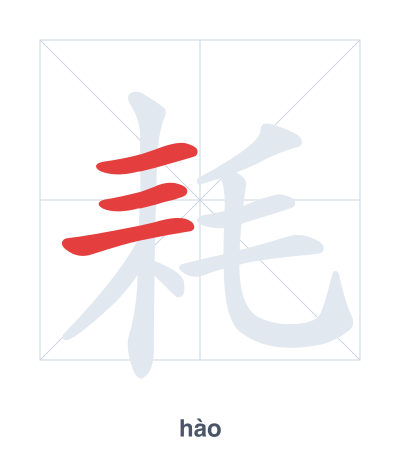
Open Hanzi Writer to see the animated stroke order and practice writing 耗 with real-time feedback.
The character 耗 (hào) is written with 10 strokes. Follow the standard Chinese stroke order: top to bottom, left to right, outside before inside. The radical 耒 is one of its key components.
Practice the correct stroke order with the Hanzi Writer app to see animated stroke-by-stroke guidance with real-time feedback.
耗 means To consume; to waste.
As an HSK Level 6 character, 耗 is an intermediate-level character.
耗 is a compound character. The radical 耒 (plow) ties it to farming, while 毛 (hair/fur) originally depicted the fine, insect-like damage that consumes grain, so the character came to mean 'to consume' or 'to waste'.
💡 Memory Tip: Picture a farmer's plow (耒) getting tangled in a giant fur (毛), wasting his time and energy.
运动消耗能量。
yùn dòng xiāo hào néng liàng
Exercise consumes energy.
这个空调很耗电。
zhè ge kōng tiáo hěn hào diàn
This air conditioner consumes a lot of power.
这项工作很耗时。
zhè xiàng gōng zuò hěn hào shí
This work is very time-consuming.
Open Hanzi Writer to see the animated stroke order and practice writing 耗 with real-time feedback.
✨ Animated stroke order · Handwriting recognition · HSK-graded practice · Free to use
耗 is made of two parts: the left radical 耒 (a plow or farming tool) and the right component 毛 (hair or fur). The radical 耒 suggests using tools for work, and 毛 may hint at something small or wasted; together they imply using up resources, like a plow consumes energy. This structure supports the meaning of consuming or wasting.