斯 (sī) means "this; such; (phonetic) 's'" in Chinese. It has 12 strokes with the radical 斤, and is HSK Level 7.
Rated 4.2/5 in difficulty (advanced).
Harder than 62% of HSK Level 7 characters.
Appears in 3+ common words including 斯文 (sī wén), 俄罗斯 (é luó sī), 威尼斯 (wēi ní sī).
Due to its 12 strokes, Hanzi Writer's error detection shows 斯 requires focused practice — most learners need 10+ attempts for consistent accuracy.
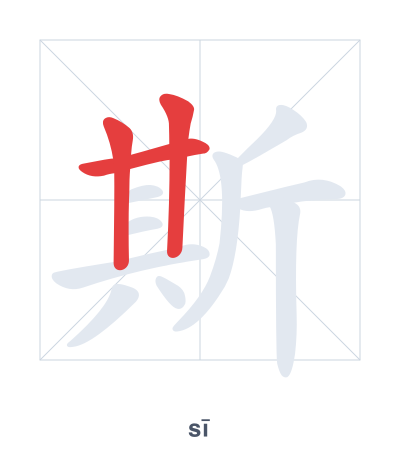
Open Hanzi Writer to see the animated stroke order and practice writing 斯 with real-time feedback.
The character 斯 (sī) is written with 12 strokes. Follow the standard Chinese stroke order: top to bottom, left to right, outside before inside. The radical 斤 is one of its key components.
Practice the correct stroke order with the Hanzi Writer app to see animated stroke-by-stroke guidance with real-time feedback.
斯 means this; such; (phonetic) 's'.
As an HSK Level 7 character, 斯 is an intermediate-level character.
斯 originally combined 其 (phonetic) with 斤 (axe), depicting the action of splitting wood. Over time it was borrowed to mean 'this' or 'such' in Classical Chinese, though the original sense of cutting is lost.
💡 Memory Tip: Picture an old craftsman chopping a log with an axe (斤) and saying 'This (斯) piece is perfect.'
他很斯文。
tā hěn sī wén
He is very refined and gentle.
他是俄罗斯人。
tā shì é luó sī rén
He is Russian.
我想去威尼斯。
wǒ xiǎng qù wēi ní sī
I want to go to Venice.
Open Hanzi Writer to see the animated stroke order and practice writing 斯 with real-time feedback.
✨ Animated stroke order · Handwriting recognition · HSK-graded practice · Free to use
斯 is made of two parts: the left side is 其 (that) and the right side is 斤 (axe). The component 其 gives the character its pronunciation sī, while 斤 is the radical. Although the original meaning of 斯 was "to split" (from the axe), in modern Chinese it is used as a classical word for "this" or "such."