斧 (fǔ) means "Axe / Hatchet" in Chinese. It has 8 strokes with the radical 斤, and is HSK Level 7.
Rated 3.7/5 in difficulty (challenging).
Harder than 26% of HSK Level 7 characters.
Appears in 3+ common words including 斧头 (fǔ tóu), 斧正 (fǔ zhèng), 斧子 (fǔ zi).
Due to its 8 strokes, Hanzi Writer's error detection shows 斧 requires focused practice — most learners need 10+ attempts for consistent accuracy.
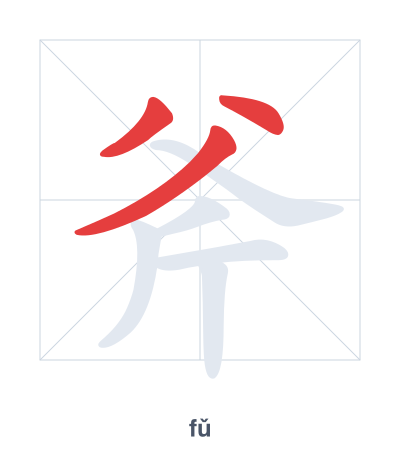
Open Hanzi Writer to see the animated stroke order and practice writing 斧 with real-time feedback.
The character 斧 (fǔ) is written with 8 strokes. Follow the standard Chinese stroke order: top to bottom, left to right, outside before inside. The radical 斤 is one of its key components.
Practice the correct stroke order with the Hanzi Writer app to see animated stroke-by-stroke guidance with real-time feedback.
斧 means Axe / Hatchet.
As an HSK Level 7 character, 斧 is an intermediate-level character.
斧 is a compound character combining 父 (fù, 'father') as a phonetic cue and 斤 (jīn, 'axe') as a semantic radical. The character visually represents a father's axe, an essential tool for household tasks in ancient times.
💡 Memory Tip: Picture a father (父) swinging a heavy axe (斤) to split a log.
他用斧头砍树。
tā yòng fǔ tóu kǎn shù
He used an axe to chop the tree.
请您多多斧正。
qǐng nín duō duō fǔ zhèng
Please feel free to make corrections.
这把斧子很锋利。
zhè bǎ fǔ zi hěn fēng lì
This axe is very sharp.
Open Hanzi Writer to see the animated stroke order and practice writing 斧 with real-time feedback.
✨ Animated stroke order · Handwriting recognition · HSK-graded practice · Free to use
The character 斧 is made of two parts: 父 (father) on top and 斤 (axe) below. The radical 斤 directly means 'axe', so the character represents a tool associated with a father figure, literally 'father's axe'.