踶 (dì) means "to kick; to tread" in Chinese. It has 16 strokes with the radical 足.
Rated 4.2/5 in difficulty (advanced).
Appears in 3+ common words including 踶跳 (dì tiào), 踶啮 (dì niè), 踶踏 (dì tà).
Due to its 16 strokes, Hanzi Writer's error detection shows 踶 requires focused practice — most learners need 10+ attempts for consistent accuracy.
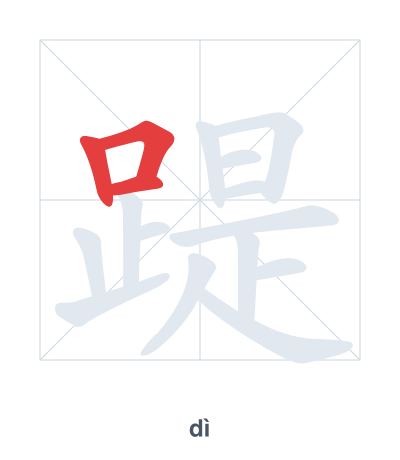
Open Hanzi Writer to see the animated stroke order and practice writing 踶 with real-time feedback.
The character 踶 (dì) is written with 16 strokes. Follow the standard Chinese stroke order: top to bottom, left to right, outside before inside. The radical 足 is one of its key components.
Practice the correct stroke order with the Hanzi Writer app to see animated stroke-by-stroke guidance with real-time feedback.
踶 means to kick; to tread.
踶 combines the radical 足 (foot) with 虒, a phonetic component that originally depicted a mythical beast. The foot radical directly ties to actions like kicking or treading, while the phonetic gives the sound dì.
💡 Memory Tip: Picture a foot (足) kicking a fierce beast (虒) so hard it falls over — that's 踶, to kick.
马在草地踶跳。
mǎ zài cǎo dì dì tiào
The horse is kicking and jumping on the grass.
驴子又踶又啮。
lǘ zi yòu dì yòu niè
The donkey kicks and bites.
别让马踶踏庄稼。
bié ràng mǎ dì tà zhuāng jià
Don't let the horse trample the crops.
Open Hanzi Writer to see the animated stroke order and practice writing 踶 with real-time feedback.
✨ Animated stroke order · Handwriting recognition · HSK-graded practice · Free to use
踶 is made of the radical 足 (foot) on the left and the character 是 (shì) on the right. The left part 足 shows that the character is related to actions of the foot, such as kicking or treading. The right part 是 provides a phonetic hint, though its pronunciation does not exactly match the pinyin dì.