啮 (niè) means "to gnaw; to bite" in Chinese. It has 11 strokes with the radical 口.
Rated 4.2/5 in difficulty (advanced).
Appears in 3+ common words including 啮齿类 (niè chǐ lèi), 啮合 (niè hé), 咬啮 (yǎo niè).
Due to its 11 strokes, Hanzi Writer's error detection shows 啮 requires focused practice — most learners need 10+ attempts for consistent accuracy.
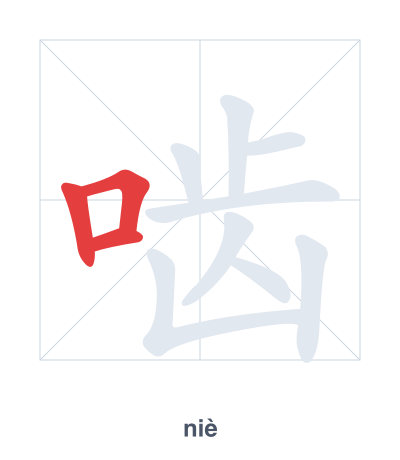
Open Hanzi Writer to see the animated stroke order and practice writing 啮 with real-time feedback.
The character 啮 (niè) is written with 11 strokes. Follow the standard Chinese stroke order: top to bottom, left to right, outside before inside. The radical 口 is one of its key components.
Practice the correct stroke order with the Hanzi Writer app to see animated stroke-by-stroke guidance with real-time feedback.
啮 means to gnaw; to bite.
The character 啮 (niè) is a compound that combines the radical 口 (mouth) with an abbreviated form of 齿 (tooth). Together, the mouth and tooth vividly depict the action of gnawing or biting with the teeth.
💡 Memory Tip: Imagine a mouth (口) with sharp teeth (齿) chomping down and gnawing on a tough piece of wood.
老鼠是啮齿类。
lǎo shǔ shì niè chǐ lèi
Mice are rodents.
齿轮正在啮合。
chǐ lún zhèng zài niè hé
The gears are meshing.
木头被虫子咬啮。
mù tou bèi chóng zi yǎo niè
The wood is being gnawed by insects.
Open Hanzi Writer to see the animated stroke order and practice writing 啮 with real-time feedback.
✨ Animated stroke order · Handwriting recognition · HSK-graded practice · Free to use
The left side is the radical 口 (mouth), and the right side is 齿 (tooth). Together, they suggest the action of using the mouth and teeth to gnaw or bite.