盗 (dào) means "to steal / thief / robber" in Chinese. It has 11 strokes with the radical 皿, and is HSK Level 6.
Rated 4.2/5 in difficulty (advanced).
Harder than 79% of HSK Level 6 characters.
Appears in 3+ common words including 强盗 (qiáng dào), 盗用 (dào yòng), 防盗 (fáng dào).
Due to its 11 strokes, Hanzi Writer's error detection shows 盗 requires focused practice — most learners need 10+ attempts for consistent accuracy.
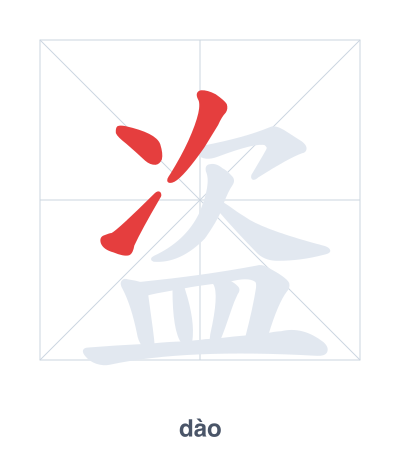
Open Hanzi Writer to see the animated stroke order and practice writing 盗 with real-time feedback.
The character 盗 (dào) is written with 11 strokes. Follow the standard Chinese stroke order: top to bottom, left to right, outside before inside. The radical 皿 is one of its key components.
Practice the correct stroke order with the Hanzi Writer app to see animated stroke-by-stroke guidance with real-time feedback.
盗 means to steal / thief / robber.
As an HSK Level 6 character, 盗 is an intermediate-level character.
The character 盗 combines 次 (originally showing a person drooling with envy) and 皿 (a vessel), depicting someone coveting another's vessel and then stealing it. The ancient form emphasized the greedy desire that leads to theft.
💡 Memory Tip: Picture a thief drooling (欠) two drops of saliva (冫) over a bowl (皿) because he wants to steal it.
警察抓住了那个强盗。
jǐng chá zhuā zhù le nà ge qiáng dào
The police caught that robber.
不要盗用别人的账号。
bú yào dào yòng bié rén de zhàng hào
Don't misappropriate someone else's account.
这扇防盗门很安全。
zhè shàn fáng dào mén hěn ān quán
This security door is very safe.
Open Hanzi Writer to see the animated stroke order and practice writing 盗 with real-time feedback.
✨ Animated stroke order · Handwriting recognition · HSK-graded practice · Free to use
盗 is composed of 次 (next/second) above 皿 (container/bowl). The radical 皿 hints at a vessel or container, while the upper part suggests something placed inside in a sneaky way, relating to theft or stealing.