扰 (rǎo) means "to disturb; to bother; to trouble" in Chinese. It has 7 strokes with the radical 扌, and is HSK Level 5.
Rated 3.5/5 in difficulty (challenging).
Harder than 24% of HSK Level 5 characters.
Appears in 3+ common words including 打扰 (dǎ rǎo), 干扰 (gān rǎo), 骚扰 (sāo rǎo).
Due to its 7 strokes, Hanzi Writer's error detection shows 扰 requires focused practice — most learners need 10+ attempts for consistent accuracy.
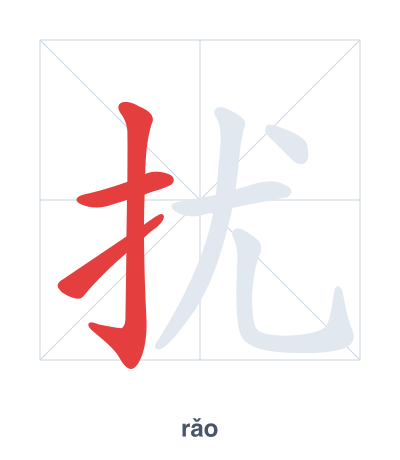
Open Hanzi Writer to see the animated stroke order and practice writing 扰 with real-time feedback.
The character 扰 (rǎo) is written with 7 strokes. Follow the standard Chinese stroke order: top to bottom, left to right, outside before inside. The radical 扌 is one of its key components.
Practice the correct stroke order with the Hanzi Writer app to see animated stroke-by-stroke guidance with real-time feedback.
扰 means to disturb; to bother; to trouble.
As an HSK Level 5 character, 扰 is an intermediate-level character.
The left radical 扌 indicates a hand action, while the right component 尤 originally depicted a person with a twisted leg, meaning 'to twist' or 'fault'. Together, they suggest a hand twisting or causing fault, i.e., disturbing or bothering someone.
💡 Memory Tip: Picture a hand (扌) grabbing a person with a twisted leg (尤) to disturb them.
对不起,打扰了。
duì bù qǐ dǎ rǎo le
Sorry to bother you.
信号受到了干扰。
xìn hào shòu dào le gān rǎo
The signal was interfered with.
别去骚扰别人。
bié qù sāo rǎo bié rén
Don't harass others.
Open Hanzi Writer to see the animated stroke order and practice writing 扰 with real-time feedback.
✨ Animated stroke order · Handwriting recognition · HSK-graded practice · Free to use
The character 扰 consists of the hand radical 扌 on the left and 尤 (yóu) on the right. The hand radical suggests an action, and 尤 can mean "fault" or "especially," so together they imply using your hand to cause trouble — to disturb or bother.