怠 (dài) means "idle; negligent" in Chinese. It has 9 strokes with the radical 心, and is HSK Level 7.
Rated 4/5 in difficulty (challenging).
Harder than 40% of HSK Level 7 characters.
Appears in 3+ common words including 懈怠 (xiè dài), 怠慢 (dài màn), 倦怠 (juàn dài).
Due to its 9 strokes, Hanzi Writer's error detection shows 怠 requires focused practice — most learners need 10+ attempts for consistent accuracy.
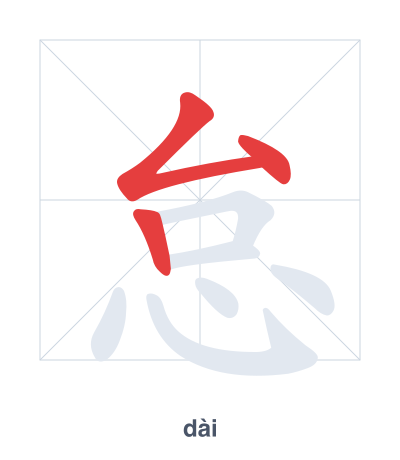
Open Hanzi Writer to see the animated stroke order and practice writing 怠 with real-time feedback.
The character 怠 (dài) is written with 9 strokes. Follow the standard Chinese stroke order: top to bottom, left to right, outside before inside. The radical 心 is one of its key components.
Practice the correct stroke order with the Hanzi Writer app to see animated stroke-by-stroke guidance with real-time feedback.
怠 means idle; negligent.
As an HSK Level 7 character, 怠 is an intermediate-level character.
怠 combines the phonetic component 台 (platform, but here indicating sound) with the radical 心 (heart/mind), suggesting a state of mind that is slack or slow, leading to idleness and negligence.
💡 Memory Tip: A heart (心) resting too long on a platform (台) grows idle and neglects its duties.
工作不能懈怠。
gōng zuò bù néng xiè dài
One shouldn't be slack at work.
招待不周,请多怠慢。
zhāo dài bù zhōu qǐng duō dài màn
Please excuse my poor hospitality.
他感到有些倦怠。
tā gǎn dào yǒu xiē juàn dài
He feels a bit weary.
Open Hanzi Writer to see the animated stroke order and practice writing 怠 with real-time feedback.
✨ Animated stroke order · Handwriting recognition · HSK-graded practice · Free to use
The character 怠 is composed of a top component 台 (tái, platform) and the bottom radical 心 (xīn, heart/mind). The heart radical suggests a state of mind, and the overall character conveys a lazy or idle mindset.