孑 (jié) means "Alone; solitary; mosquito larva" in Chinese. It has 3 strokes with the radical 子.
Rated 2.2/5 in difficulty (moderate).
Appears in 3+ common words including 孑然 (jié rán), 孑孓 (jié jué), 孑遗 (jié yí).
Hanzi Writer's stroke validation shows learners typically need 5-8 attempts to write 孑 with correct proportion and order.
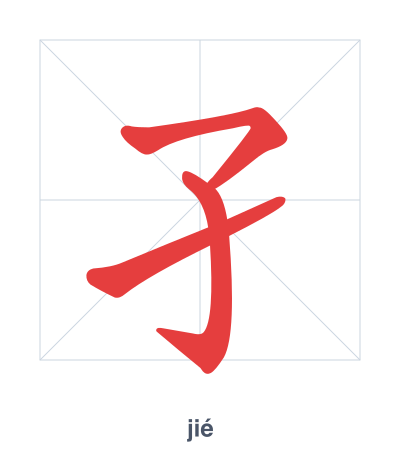
Open Hanzi Writer to see the animated stroke order and practice writing 孑 with real-time feedback.
The character 孑 (jié) is written with 3 strokes. Follow the standard Chinese stroke order: top to bottom, left to right, outside before inside. The radical 子 is one of its key components.
Practice the correct stroke order with the Hanzi Writer app to see animated stroke-by-stroke guidance with real-time feedback.
孑 means Alone; solitary; mosquito larva.
| Character | 孑 |
| Pinyin | jié (jie) |
| Meaning | Alone; solitary; mosquito larva |
| Strokes | 3 |
| Radical | 子 |
| Difficulty | 2.2/5 |
Ancient texts show 孑 as a pictograph of a child (子) missing one arm, symbolizing incompleteness and solitude. This image also relates to mosquito larvae, which are tiny, solitary wigglers in water.
💡 Memory Tip: Imagine a single child (子) with only one arm—the missing arm makes it feel completely alone.
他孑然一身。
tā jié rán yī shēn
He is all alone.
水里有孑孓。
shuǐ lǐ yǒu jié jué
There are mosquito larvae in the water.
这是孑遗植物。
zhè shì jié yí zhí wù
This is a relict plant.
Open Hanzi Writer to see the animated stroke order and practice writing 孑 with real-time feedback.
✨ Animated stroke order · Handwriting recognition · HSK-graded practice · Free to use
孑 is composed of the radical 子 (child) with one arm missing — the left stroke is absent, leaving only the right side. This visual incompleteness reinforces its meanings of 'alone' or 'solitary,' like a child without companions. It also depicts the shape of a mosquito larva, which is a small, lone creature wriggling in water.