孔 (kǒng) means "hole; opening; (a surname)" in Chinese. It has 4 strokes with the radical 子.
Rated 2.7/5 in difficulty (moderate).
Appears in 3+ common words including 孔子 (kǒng zi), 鼻孔 (bí kǒng), 孔雀 (kǒng què).
Hanzi Writer's stroke validation shows learners typically need 5-8 attempts to write 孔 with correct proportion and order.
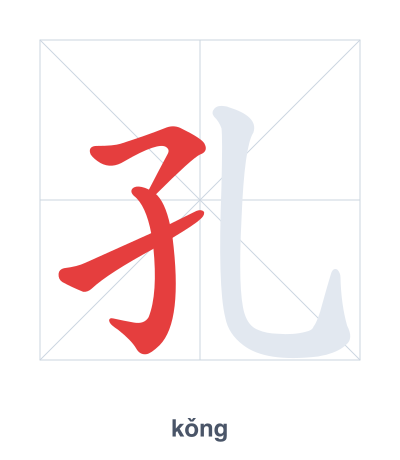
Open Hanzi Writer to see the animated stroke order and practice writing 孔 with real-time feedback.
The character 孔 (kǒng) is written with 4 strokes. Follow the standard Chinese stroke order: top to bottom, left to right, outside before inside. The radical 子 is one of its key components.
Practice the correct stroke order with the Hanzi Writer app to see animated stroke-by-stroke guidance with real-time feedback.
孔 means hole; opening; (a surname).
| Character | 孔 |
| Pinyin | kǒng (kong) |
| Meaning | hole; opening; (a surname) |
| Strokes | 4 |
| Radical | 子 |
| Difficulty | 2.7/5 |
孔 originally depicted a child (子) with a small mark indicating the fontanel, the soft, open hole on a baby's head. Over time, this image generalized to mean any hole or opening.
💡 Memory Tip: Picture a child (子) with a giant, round mouth (the curved line 乚) wide open like a dark hole.
孔子是教育家。
kǒng zi shì jiào yù jiā
Confucius was an educator.
他的鼻孔很大。
tā de bí kǒng hěn dà
His nostrils are very large.
孔雀开屏了。
kǒng què kāi píng le
The peacock spread its tail feathers.
Open Hanzi Writer to see the animated stroke order and practice writing 孔 with real-time feedback.
✨ Animated stroke order · Handwriting recognition · HSK-graded practice · Free to use
孔 is a left-right character. The left part is 子 (child), and the right part is a curved stroke that suggests a hole or opening. Together, the components hint at the meaning 'hole' or 'opening', though the exact origin is debated.