篡 (cuàn) means "to usurp or seize" in Chinese. It has 16 strokes with the radical 竹.
Rated 3.9/5 in difficulty (challenging).
Appears in 3+ common words including 篡改 (cuàn gǎi), 篡位 (cuàn wèi), 篡夺 (cuàn duó).
Due to its 16 strokes, Hanzi Writer's error detection shows 篡 requires focused practice — most learners need 10+ attempts for consistent accuracy.
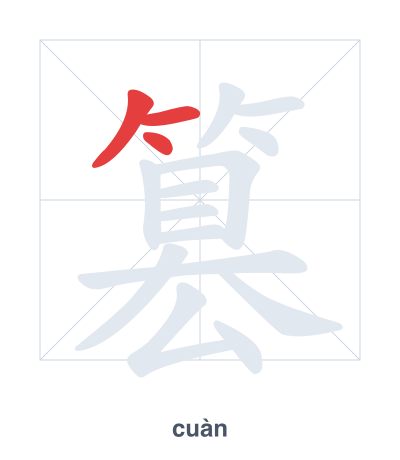
Open Hanzi Writer to see the animated stroke order and practice writing 篡 with real-time feedback.
The character 篡 (cuàn) is written with 16 strokes. Follow the standard Chinese stroke order: top to bottom, left to right, outside before inside. The radical 竹 is one of its key components.
Practice the correct stroke order with the Hanzi Writer app to see animated stroke-by-stroke guidance with real-time feedback.
篡 means to usurp or seize.
篡 combines 竹 (bamboo, used for writing slips) with 算 (to calculate, plan), suggesting the act of altering official documents or cunningly plotting to seize power. In ancient China, bamboo slips recorded state affairs, so the character implies fraudulent manipulation to usurp a position or throne.
💡 Memory Tip: Picture a sly advisor using bamboo slips to calculate (算) a scheme, then snatching the emperor's crown from his head with a quick 'cuàn' grab.
别篡改我的话。
bié cuàn gǎi wǒ de huà
Don't twist my words.
他想篡位当皇帝。
tā xiǎng cuàn wèi dāng huáng dì
He wants to usurp the throne and become emperor.
权力被篡夺了。
quán lì bèi cuàn duó le
The power was usurped.
Open Hanzi Writer to see the animated stroke order and practice writing 篡 with real-time feedback.
✨ Animated stroke order · Handwriting recognition · HSK-graded practice · Free to use
The character 篡 combines the radical 竹 (bamboo) at the top with 算 (suàn, to calculate) underneath. The bamboo radical suggests something written or recorded, while 算 implies calculation or planning, together reinforcing the idea of secretly manipulating records or plans to seize power.