赐 (cì) means "to bestow; to grant (by a superior)" in Chinese. It has 12 strokes with the radical 贝, and is HSK Level 7.
Rated 4.2/5 in difficulty (advanced).
Harder than 91% of HSK Level 7 characters.
Appears in 3+ common words including 赐教 (cì jiào), 赏赐 (shǎng cì), 恩赐 (ēn cì).
Due to its 12 strokes, Hanzi Writer's error detection shows 赐 requires focused practice — most learners need 10+ attempts for consistent accuracy.
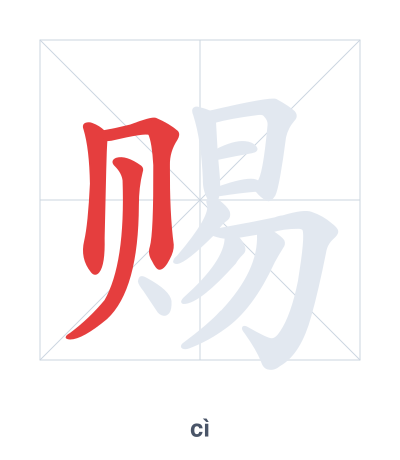
Open Hanzi Writer to see the animated stroke order and practice writing 赐 with real-time feedback.
The character 赐 (cì) is written with 12 strokes. Follow the standard Chinese stroke order: top to bottom, left to right, outside before inside. The radical 贝 is one of its key components.
Practice the correct stroke order with the Hanzi Writer app to see animated stroke-by-stroke guidance with real-time feedback.
赐 means to bestow; to grant (by a superior).
As an HSK Level 7 character, 赐 is an intermediate-level character.
The character 赐 combines the radical 贝 (shell/money, symbolizing wealth) with the phonetic component 易 (change/exchange). Together, they depict the act of a superior bestowing valuable gifts, where wealth changes hands from giver to receiver.
💡 Memory Tip: Picture a wealthy official (贝) casually handing over a bag of coins—the gift easily (易) changes ownership as a royal grant.
请多多赐教。
qǐng duō duō cì jiào
Please give me your guidance.
皇帝给了他赏赐。
huáng dì gěi le tā shǎng cì
The Emperor gave him a reward.
这是上天的恩赐。
zhè shì shàng tiān de ēn cì
This is a gift from heaven.
Open Hanzi Writer to see the animated stroke order and practice writing 赐 with real-time feedback.
✨ Animated stroke order · Handwriting recognition · HSK-graded practice · Free to use
赐 is composed of two parts: the radical 贝 (shell/money) on the left, and 易 (yì, meaning 'easy' or 'change') on the right. The radical 贝 connects to wealth or valuables, while 易 contributes sound and suggests a transfer, together meaning to bestow or grant something valuable from a superior.