蠃 (luǒ) means "solitary wasp" in Chinese. It has 19 strokes with the radical 虫.
Rated 4.2/5 in difficulty (advanced).
Appears in 3+ common words including 螟蠃 (míng luǒ), 蠃子 (luǒ zi), 蠃虫 (luǒ chóng).
Due to its 19 strokes, Hanzi Writer's error detection shows 蠃 requires focused practice — most learners need 10+ attempts for consistent accuracy.
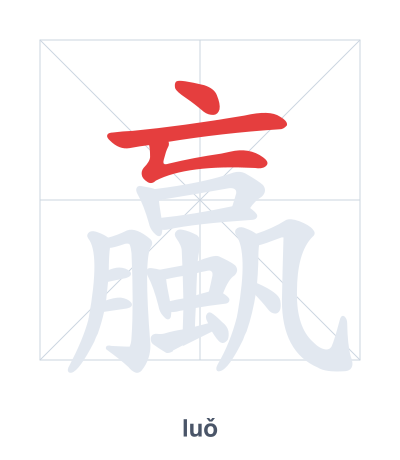
Open Hanzi Writer to see the animated stroke order and practice writing 蠃 with real-time feedback.
The character 蠃 (luǒ) is written with 19 strokes. Follow the standard Chinese stroke order: top to bottom, left to right, outside before inside. The radical 虫 is one of its key components.
Practice the correct stroke order with the Hanzi Writer app to see animated stroke-by-stroke guidance with real-time feedback.
蠃 means solitary wasp.
蠃 is a compound character: the radical 虫 (insect) signals it is an insect, while the remaining component 羸 (thin) hints at the solitary wasp's slender body. The character originally referred to a type of wasp that builds solitary mud nests.
💡 Memory Tip: Picture a solitary wasp (虫) with a super skinny waist (羸) as it tirelessly molds mud into a tiny pot for its egg.
螟蠃在花丛中飞。
míng luǒ zài huā cóng zhōng fēi
The mason wasp is flying among the flowers.
蠃子是一种小昆虫。
luǒ zi shì yī zhǒng xiǎo kūn chóng
The solitary wasp is a small insect.
蠃虫在叶子上。
luǒ chóng zài yè zi shàng
The insect is on the leaf.
Open Hanzi Writer to see the animated stroke order and practice writing 蠃 with real-time feedback.
✨ Animated stroke order · Handwriting recognition · HSK-graded practice · Free to use
蠃 is composed of 𣎆 (a phonetic component suggesting the sound luǒ) on top, and 虫 (insect) below. The 虫 radical directly indicates that this character refers to a type of insect, specifically a solitary wasp.