蟹 (xiè) means "crab" in Chinese. It has 19 strokes with the radical 虫.
Rated 4.2/5 in difficulty (advanced).
Appears in 3+ common words including 螃蟹 (páng xiè), 蟹肉 (xiè ròu), 蟹黄 (xiè huáng).
Due to its 19 strokes, Hanzi Writer's error detection shows 蟹 requires focused practice — most learners need 10+ attempts for consistent accuracy.
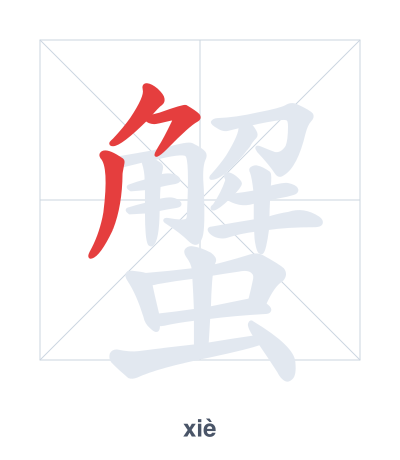
Open Hanzi Writer to see the animated stroke order and practice writing 蟹 with real-time feedback.
The character 蟹 (xiè) is written with 19 strokes. Follow the standard Chinese stroke order: top to bottom, left to right, outside before inside. The radical 虫 is one of its key components.
Practice the correct stroke order with the Hanzi Writer app to see animated stroke-by-stroke guidance with real-time feedback.
蟹 means crab.
The character 蟹 combines the radical 虫 (insect/crustacean) with 解 (to untie), which provides phonetic cues and hints at the crab's jointed legs and ability to shed its shell. The left side 虫 identifies it as a creature, while 解 suggests the crab's segmented body and pincers that open and close like a latch.
💡 Memory Tip: Picture a crab (虫) using its claws to untie (解) a tangled fishing net.
我们今天吃螃蟹。
wǒ men jīn tiān chī páng xiè
We are eating crabs today.
蟹肉的味道很鲜。
xiè ròu de wèi dào hěn xiān
Crab meat tastes very fresh.
蟹黄非常好吃。
xiè huáng fēi cháng hǎo chī
Crab roe is very delicious.
Open Hanzi Writer to see the animated stroke order and practice writing 蟹 with real-time feedback.
✨ Animated stroke order · Handwriting recognition · HSK-graded practice · Free to use
The character 蟹 is made of two parts: the left radical 虫 (insect or creature) and the right part 解 (to untie or separate). The 虫 radical shows that a crab is a type of animal, while 解 hints at the crab's claws which can cut or pinch things apart. Together, they create the idea of a "creature that cuts" — a crab.