蟾 (chán) means "toad" in Chinese. It has 19 strokes with the radical 虫.
Rated 4.2/5 in difficulty (advanced).
Appears in 3+ common words including 蟾蜍 (chán chú), 蟾宫 (chán gōng), 蟾影 (chán yǐng).
Due to its 19 strokes, Hanzi Writer's error detection shows 蟾 requires focused practice — most learners need 10+ attempts for consistent accuracy.
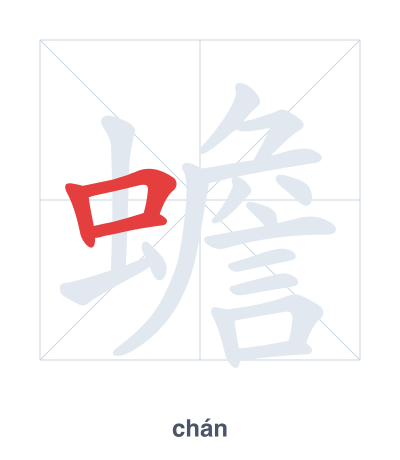
Open Hanzi Writer to see the animated stroke order and practice writing 蟾 with real-time feedback.
The character 蟾 (chán) is written with 19 strokes. Follow the standard Chinese stroke order: top to bottom, left to right, outside before inside. The radical 虫 is one of its key components.
Practice the correct stroke order with the Hanzi Writer app to see animated stroke-by-stroke guidance with real-time feedback.
蟾 means toad.
蟾 is a phono-semantic compound. The radical 虫 (insect/reptile) indicates it is a creature like a toad, while the phonetic component 詹 (zhān) provides the pronunciation. In Chinese mythology, the toad is often associated with the moon, but the character itself simply combines these visual elements.
💡 Memory Tip: Picture a toad (虫) on a cliff (厂) croaking eight (八) loud words (言).
蟾蜍在池塘边跳。
chán chú zài chí táng biān tiào
The toad is jumping by the pond.
蟾宫是月亮的别称。
chán gōng shì yuè liàng de bié chēng
'Toad Palace' is another name for the moon.
湖面上有蟾影。
hú miàn shàng yǒu chán yǐng
There is a reflection of the moon on the lake surface.
Open Hanzi Writer to see the animated stroke order and practice writing 蟾 with real-time feedback.
✨ Animated stroke order · Handwriting recognition · HSK-graded practice · Free to use
The left side is the radical 虫 (chóng), which means "insect" or "creature," indicating that 蟾 is an animal. The right side is 詹 (zhān), which provides the pronunciation chán. Together, this phono-semantic compound means "toad."