瘳 (chōu) means "to recover from illness" in Chinese. It has 16 strokes with the radical 疒.
Rated 4.2/5 in difficulty (advanced).
Appears in 3+ common words including 瘳愈 (chōu yù), 未瘳 (wèi chōu), 获瘳 (huò chōu).
Due to its 16 strokes, Hanzi Writer's error detection shows 瘳 requires focused practice — most learners need 10+ attempts for consistent accuracy.
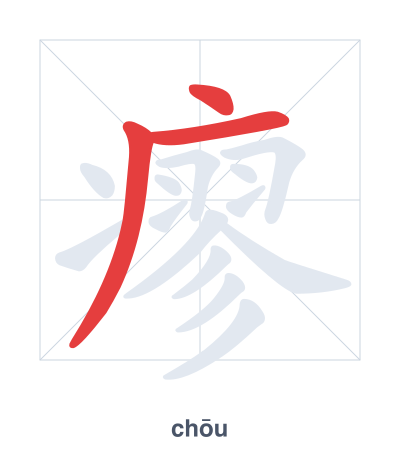
Open Hanzi Writer to see the animated stroke order and practice writing 瘳 with real-time feedback.
The character 瘳 (chōu) is written with 16 strokes. Follow the standard Chinese stroke order: top to bottom, left to right, outside before inside. The radical 疒 is one of its key components.
Practice the correct stroke order with the Hanzi Writer app to see animated stroke-by-stroke guidance with real-time feedback.
瘳 means to recover from illness.
瘳 is a phono-semantic compound: the radical 疒 (sickness) conveys the meaning of illness, while the component 翏 (liù, originally depicting a person blowing air) provides phonetic cues and also suggests the idea of illness being ‘blown away,’ symbolizing recovery.
💡 Memory Tip: A sick person (疒) blows a feather (羽) three times (㐱) to chase the illness away — and they recover.
他的病已经瘳愈了。
tā de bìng yǐ jīng chōu yù le
He has fully recovered from his illness.
他的病至今未瘳。
tā de bìng zhì jīn wèi chōu
He has not yet recovered from his illness.
经过治疗,他已获瘳。
jīng guò zhì liáo tā yǐ huò chōu
After treatment, he has recovered from his illness.
Open Hanzi Writer to see the animated stroke order and practice writing 瘳 with real-time feedback.
✨ Animated stroke order · Handwriting recognition · HSK-graded practice · Free to use
The character 瘳 is composed of the radical 疒 (illness) on the left and 翏 (liù) on the right. The radical 疒 indicates that the meaning is related to sickness, while 翏 provides phonetic and semantic hints—it originally meant "to heal" or "to cure." Together, 瘳 expresses the idea of recovering from illness.