橙 (chéng) means "orange (fruit or color)" in Chinese. It has 16 strokes with the radical 木, and is HSK Level 7.
Rated 4.2/5 in difficulty (advanced).
Harder than 65% of HSK Level 7 characters.
Appears in 3+ common words including 橙子 (chéng zi), 橙色 (chéng sè), 橙汁 (chéng zhī).
Due to its 16 strokes, Hanzi Writer's error detection shows 橙 requires focused practice — most learners need 10+ attempts for consistent accuracy.
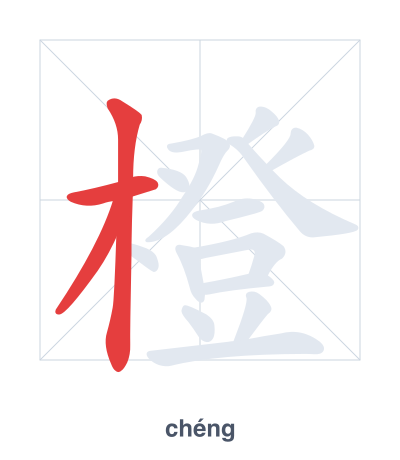
Open Hanzi Writer to see the animated stroke order and practice writing 橙 with real-time feedback.
The character 橙 (chéng) is written with 16 strokes. Follow the standard Chinese stroke order: top to bottom, left to right, outside before inside. The radical 木 is one of its key components.
Practice the correct stroke order with the Hanzi Writer app to see animated stroke-by-stroke guidance with real-time feedback.
橙 means orange (fruit or color).
As an HSK Level 7 character, 橙 is an intermediate-level character.
橙 is a phono-semantic compound. The radical 木 (tree) indicates it is a type of tree or fruit, while 登 (deng, meaning 'to ascend' or 'ladder') provides the pronunciation and may evoke the idea of climbing to pick oranges from a tall tree.
💡 Memory Tip: Imagine climbing a ladder (登) up a tree (木) to pick a bright orange fruit as the sun rises.
橙子含有维生素C。
chéng zi hán yǒu wéi shēng sù C。
Oranges contain vitamin C.
她穿着橙色的毛衣。
tā chuān zhe chéng sè de máo yī
She is wearing an orange sweater.
早餐我喝了橙汁。
zǎo cān wǒ hē le chéng zhī
I drank orange juice for breakfast.
Open Hanzi Writer to see the animated stroke order and practice writing 橙 with real-time feedback.
✨ Animated stroke order · Handwriting recognition · HSK-graded practice · Free to use
The character 橙 combines the radical 木 (wood/tree) on the left and 登 on the right. The wood radical shows that the character relates to a tree or fruit, as oranges grow on trees. The right part 登 originally suggests climbing, but here it mainly provides pronunciation (chéng) and helps form the complete character.