榍 (xiè) means "Sphene" in Chinese. It has 14 strokes with the radical 木.
Rated 4.2/5 in difficulty (advanced).
Appears in 3+ common words including 榍石 (xiè shí), 榍石晶体 (xiè shí jīng tǐ), 榍石矿 (xiè shí kuàng).
Due to its 14 strokes, Hanzi Writer's error detection shows 榍 requires focused practice — most learners need 10+ attempts for consistent accuracy.
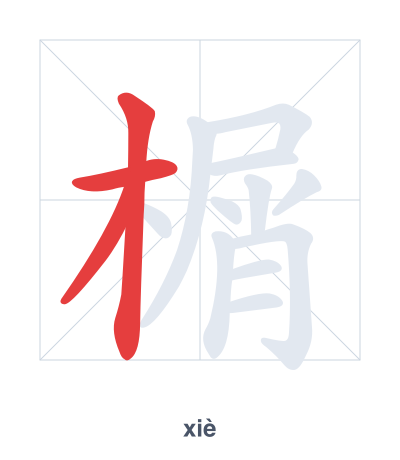
Open Hanzi Writer to see the animated stroke order and practice writing 榍 with real-time feedback.
The character 榍 (xiè) is written with 14 strokes. Follow the standard Chinese stroke order: top to bottom, left to right, outside before inside. The radical 木 is one of its key components.
Practice the correct stroke order with the Hanzi Writer app to see animated stroke-by-stroke guidance with real-time feedback.
榍 means Sphene.
榍 is a phono-semantic compound combining the radical 木 (tree) with 屑 (xiè, meaning bits or fragments). The component 屑 provides the pronunciation and hints at the small crystals of sphene, a mineral that often occurs as tiny grains. The presence of 木 may allude to the mineral's resinous, wood-like luster or its occurrence in vein-like formations.
💡 Memory Tip: Imagine a wooden (木) log covered in tiny sparkling bits (屑) of sphene mineral that look like golden splinters.
榍石是矿物。
xiè shí shì kuàng wù
Sphene is a mineral.
晶体很漂亮。
jīng tǐ hěn piào liàng
The crystal is very beautiful.
这里有榍石矿。
zhè lǐ yǒu xiè shí kuàng
There is a sphene mine here.
Open Hanzi Writer to see the animated stroke order and practice writing 榍 with real-time feedback.
✨ Animated stroke order · Handwriting recognition · HSK-graded practice · Free to use
榍 is made of two parts: the left radical 木 (wood/tree) and the right component 屑 (xiè, meaning 'bits' or 'shavings'). The 木 radical hints at minerals or stone (since wood and stone are both natural materials), while 屑 suggests small fragments, together describing sphene as a mineral found in tiny crystal pieces.