榕 (róng) means "Banyan" in Chinese. It has 14 strokes with the radical 木.
Rated 4.2/5 in difficulty (advanced).
Appears in 3+ common words including 榕树 (róng shù), 大榕树 (dà róng shù), 榕城 (róng chéng).
Due to its 14 strokes, Hanzi Writer's error detection shows 榕 requires focused practice — most learners need 10+ attempts for consistent accuracy.
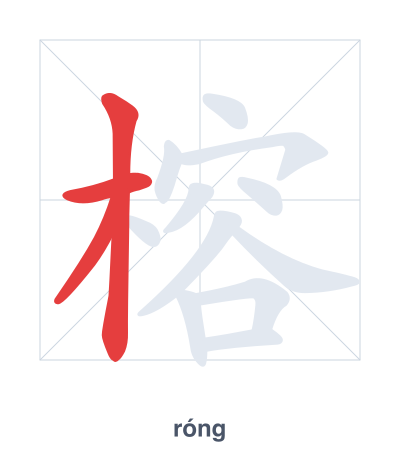
Open Hanzi Writer to see the animated stroke order and practice writing 榕 with real-time feedback.
The character 榕 (róng) is written with 14 strokes. Follow the standard Chinese stroke order: top to bottom, left to right, outside before inside. The radical 木 is one of its key components.
Practice the correct stroke order with the Hanzi Writer app to see animated stroke-by-stroke guidance with real-time feedback.
榕 means Banyan.
榕 is a compound character with the tree radical 木 and the phonetic component 容 (róng, meaning 'appearance' or 'to contain'). The banyan tree is known for its expansive, containing canopy and aerial roots that make it appear as if multiple trees grow from one.
💡 Memory Tip: Picture a tree (木) with so many hanging roots that it looks like it could contain (容) a whole forest under its shade.
榕树很大。
róng shù hěn dà
The banyan tree is very large.
树下很凉快。
shù xià hěn liáng kuài
It is very cool under the tree.
福州也叫榕城。
fú zhōu yě jiào róng chéng
Fuzhou is also known as the Banyan City.
Open Hanzi Writer to see the animated stroke order and practice writing 榕 with real-time feedback.
✨ Animated stroke order · Handwriting recognition · HSK-graded practice · Free to use
The character 榕 is made of the radical 木 (tree) on the left and 容 (róng, 'contain' or 'appearance') on the right. The tree radical shows it is a type of tree, and the right part hints at the banyan's large size, which can "contain" many people or objects under its canopy.