膊 (bó) means "arm / shoulder" in Chinese. It has 14 strokes with the radical 月, and is HSK Level 7.
Rated 4.2/5 in difficulty (advanced).
Harder than 84% of HSK Level 7 characters.
Appears in 3+ common words including 胳膊 (gē bó), 赤膊 (chì bó), 胳膊肘 (gē bó zhǒu).
Due to its 14 strokes, Hanzi Writer's error detection shows 膊 requires focused practice — most learners need 10+ attempts for consistent accuracy.
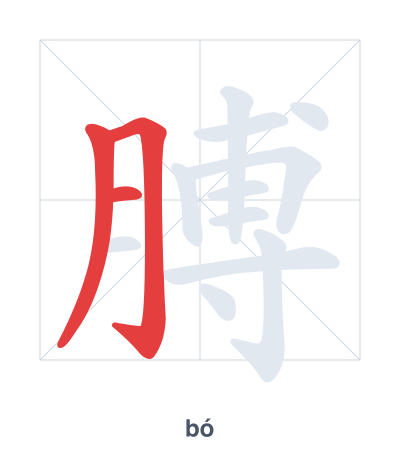
Open Hanzi Writer to see the animated stroke order and practice writing 膊 with real-time feedback.
The character 膊 (bó) is written with 14 strokes. Follow the standard Chinese stroke order: top to bottom, left to right, outside before inside. The radical 月 is one of its key components.
Practice the correct stroke order with the Hanzi Writer app to see animated stroke-by-stroke guidance with real-time feedback.
膊 means arm / shoulder.
As an HSK Level 7 character, 膊 is an intermediate-level character.
膊 is a compound character: the radical 月 (flesh) indicates a body part, while the phonetic component 尃 (fū) suggests the sound. The character specifically refers to the upper arm or shoulder area, combining the idea of flesh with a sound element that originally depicted a hand placing something, reinforcing the sense of a limb joint.
💡 Memory Tip: Imagine a fleshy arm (月) with a square, broad shoulder pad (尃) strapped on top, ready for battle.
我的胳膊很疼。
wǒ de gē bó hěn téng
My arm hurts a lot.
他光着赤膊。
tā guāng zhe chì bó
He was bare-chested.
他的胳膊肘红了。
tā de gē bó zhǒu hóng le
His elbow is red.
Open Hanzi Writer to see the animated stroke order and practice writing 膊 with real-time feedback.
✨ Animated stroke order · Handwriting recognition · HSK-graded practice · Free to use
The left side is 月, the flesh radical, indicating this character relates to a body part. The right side 尃 provides the pronunciation bó, and together they form the meaning of 'arm' or 'shoulder.'