辫 (biàn) means "braid; pigtail." in Chinese. It has 17 strokes with the radical 辛, and is HSK Level 7.
Rated 4.2/5 in difficulty (advanced).
Harder than 92% of HSK Level 7 characters.
Appears in 3+ common words including 辫子 (biàn zi), 梳辫子 (shū biàn zi), 马尾辫 (mǎ wěi biàn).
Due to its 17 strokes, Hanzi Writer's error detection shows 辫 requires focused practice — most learners need 10+ attempts for consistent accuracy.
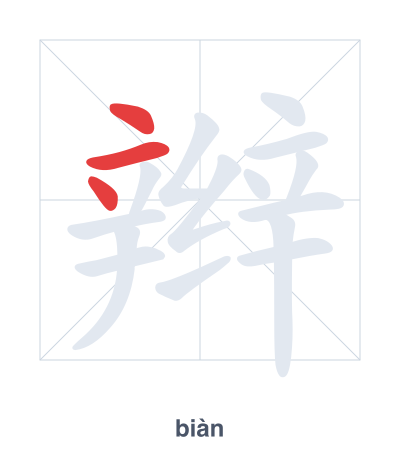
Open Hanzi Writer to see the animated stroke order and practice writing 辫 with real-time feedback.
The character 辫 (biàn) is written with 17 strokes. Follow the standard Chinese stroke order: top to bottom, left to right, outside before inside. The radical 辛 is one of its key components.
Practice the correct stroke order with the Hanzi Writer app to see animated stroke-by-stroke guidance with real-time feedback.
辫 means braid; pigtail..
As an HSK Level 7 character, 辫 is an intermediate-level character.
辫 combines 纟 (silk thread) for the material used to tie braids, and 辡 (two 辛 side by side) which provides the sound biàn and visually suggests two strands of hair being twisted together.
💡 Memory Tip: Picture two spicy (辛) strands of hair twisted with silk (纟) to form a braid.
那个女孩扎着长辫子。
nà ge nǚ hái zhā zhe zhǎng biàn zi
That girl has long braids.
妈妈在帮我梳辫子。
mā mā zài bāng wǒ shū biàn zi
Mom is helping me braid my hair.
她喜欢扎马尾辫。
tā xǐ huān zhā mǎ wěi biàn
She likes to wear her hair in a ponytail.
Open Hanzi Writer to see the animated stroke order and practice writing 辫 with real-time feedback.
✨ Animated stroke order · Handwriting recognition · HSK-graded practice · Free to use
辫 is made of three parts: 辛 (spicy/hard) on the left, 纟 (silk thread) in the middle, and 辡 (similar to 辫 in meaning) on the right. The 纟 component represents threads or hair, and the right side suggests the twisting action, together forming the idea of braided hair.