梳 (shū) means "comb; to comb" in Chinese. It has 11 strokes with the radical 木, and is HSK Level 7.
Rated 4.2/5 in difficulty (advanced).
Harder than 64% of HSK Level 7 characters.
Appears in 3+ common words including 梳子 (shū zi), 梳头 (shū tóu), 梳理 (shū lǐ).
Due to its 11 strokes, Hanzi Writer's error detection shows 梳 requires focused practice — most learners need 10+ attempts for consistent accuracy.
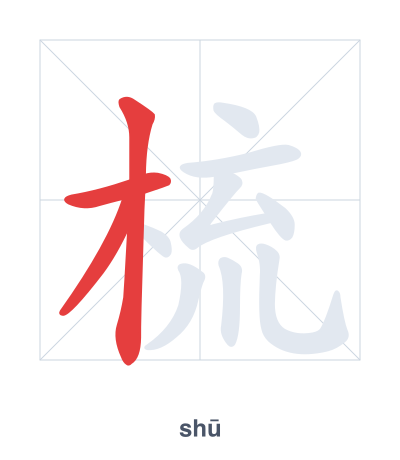
Open Hanzi Writer to see the animated stroke order and practice writing 梳 with real-time feedback.
The character 梳 (shū) is written with 11 strokes. Follow the standard Chinese stroke order: top to bottom, left to right, outside before inside. The radical 木 is one of its key components.
Practice the correct stroke order with the Hanzi Writer app to see animated stroke-by-stroke guidance with real-time feedback.
梳 means comb; to comb.
As an HSK Level 7 character, 梳 is an intermediate-level character.
梳 is a phono-semantic compound. The left radical 木 (wood) indicates the material, as early combs were made from wood. The right component 㐬 provides the pronunciation shū and originally depicted a flowing stream, but here it functions purely as a phonetic hint.
💡 Memory Tip: Imagine a wooden (木) comb with a curved handle (the top of 㐬) and a row of teeth (the bottom strokes) gliding through tangled hair.
我买了一把新梳子。
wǒ mǎi le yī bǎ xīn shū zi
I bought a new comb.
她每天早上都梳头。
tā měi tiān zǎo shàng dōu shū tóu
She combs her hair every morning.
他在梳理自己的头发。
tā zài shū lǐ zì jǐ de tóu fà
He is combing his hair.
Open Hanzi Writer to see the animated stroke order and practice writing 梳 with real-time feedback.
✨ Animated stroke order · Handwriting recognition · HSK-graded practice · Free to use
The left side is the radical 木 (wood), which tells you that a comb is traditionally made from wood. The right side 㐬 (shū) gives a clue to the pronunciation and also suggests the flowing motion of combing through hair.