辜 (gū) means "guilt; fault; crime." in Chinese. It has 12 strokes with the radical 辛, and is HSK Level 7.
Rated 4.2/5 in difficulty (advanced).
Harder than 92% of HSK Level 7 characters.
Appears in 3+ common words including 无辜 (wú gū), 辜负 (gū fù), 死有余辜 (sǐ yǒu yú gū).
Due to its 12 strokes, Hanzi Writer's error detection shows 辜 requires focused practice — most learners need 10+ attempts for consistent accuracy.
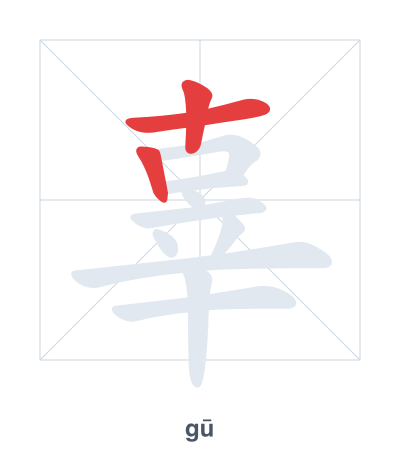
Open Hanzi Writer to see the animated stroke order and practice writing 辜 with real-time feedback.
The character 辜 (gū) is written with 12 strokes. Follow the standard Chinese stroke order: top to bottom, left to right, outside before inside. The radical 辛 is one of its key components.
Practice the correct stroke order with the Hanzi Writer app to see animated stroke-by-stroke guidance with real-time feedback.
辜 means guilt; fault; crime..
As an HSK Level 7 character, 辜 is an intermediate-level character.
辜 is a phono-semantic compound. The top component 辛 (bitter, punishment) signifies crime or wrongdoing, while the bottom 古 (gǔ, ancient) provides phonetic value, together suggesting an old transgression that brings bitter consequences.
💡 Memory Tip: Picture an ancient (古) criminal being pricked by a bitter thorn (辛) as punishment for his guilt.
他是无辜的。
tā shì wú gū de
He is innocent.
别辜负我的心意。
bié gū fù wǒ de xīn yì
Don't let my good intentions go to waste.
这个坏人死有余辜。
zhè ge huài rén sǐ yǒu yú gū
This villain deserves his death.
Open Hanzi Writer to see the animated stroke order and practice writing 辜 with real-time feedback.
✨ Animated stroke order · Handwriting recognition · HSK-graded practice · Free to use
辜 is composed of two parts: the top 古 (gǔ, ancient) and the bottom 辛 (xīn, bitter or hard labor). The radical 辛 on the bottom suggests punishment or suffering, while 古 adds the idea of "ancient" or "established" — together implying an ancient or serious offense deserving bitter punishment.