臂 (bei/bì) means "arm" in Chinese. It has 17 strokes with the radical 月, and is HSK Level 7.
Rated 4.2/5 in difficulty (advanced).
Harder than 84% of HSK Level 7 characters.
Appears in 3+ common words including 手臂 (shǒu bì), 臂膀 (bì bǎng), 胳臂 (gē bei).
Due to its 17 strokes, Hanzi Writer's error detection shows 臂 requires focused practice — most learners need 10+ attempts for consistent accuracy.
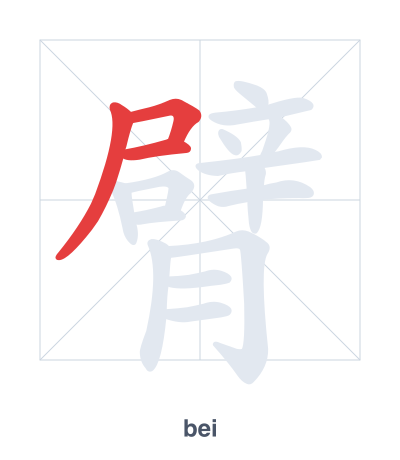
Open Hanzi Writer to see the animated stroke order and practice writing 臂 with real-time feedback.
The character 臂 (bei/bì) is written with 17 strokes. Follow the standard Chinese stroke order: top to bottom, left to right, outside before inside. The radical 月 is one of its key components.
Practice the correct stroke order with the Hanzi Writer app to see animated stroke-by-stroke guidance with real-time feedback.
臂 means arm.
This is a polyphonic character with readings: bei, bì.
As an HSK Level 7 character, 臂 is an intermediate-level character.
臂 is a phono-semantic compound. The radical 月 (flesh/body) indicates it is a body part, while 辟 (bì) provides the pronunciation and also hints at the meaning of "side" — the arm is a limb on the side of the body.
💡 Memory Tip: Picture a muscular arm flexing, with the left side (月) showing flesh and the right side (辟) looking like a bent elbow ready to break something.
运动员的手臂线条看起来非常强壮有力。
yùn dòng yuán de shǒu bì xiàn tiáo kàn qǐ lái fēi cháng qiáng zhuàng yǒu lì
The athlete's arm muscles look very strong and powerful.
父亲那宽厚的臂膀是孩子们最温暖的港湾。
fù qīn nà kuān hòu de bì bǎng shì hái zi men zuì wēn nuǎn de gǎng wān
A father's broad shoulders are the warmest harbor for his children.
他的胳臂不小心撞到了门框上。
tā de gē bei bù xiǎo xīn zhuàng dào le mén kuāng shàng
He accidentally bumped his arm against the door frame.
Open Hanzi Writer to see the animated stroke order and practice writing 臂 with real-time feedback.
✨ Animated stroke order · Handwriting recognition · HSK-graded practice · Free to use
臂 (arm) is made of two parts: the left side 月 (flesh/body) and the right side 辟 (a phonetic component). The 月 radical shows the meaning relates to a body part, while 辟 gives a hint to the pronunciation (bì). So 臂 is a body part — the arm.