膘 (biāo) means "fat (of animals); blubber" in Chinese. It has 15 strokes with the radical 月.
Rated 4.2/5 in difficulty (advanced).
Appears in 3+ common words including 肥膘 (féi biāo), 贴秋膘 (tiē qiū biāo), 膘情 (biāo qíng).
Due to its 15 strokes, Hanzi Writer's error detection shows 膘 requires focused practice — most learners need 10+ attempts for consistent accuracy.
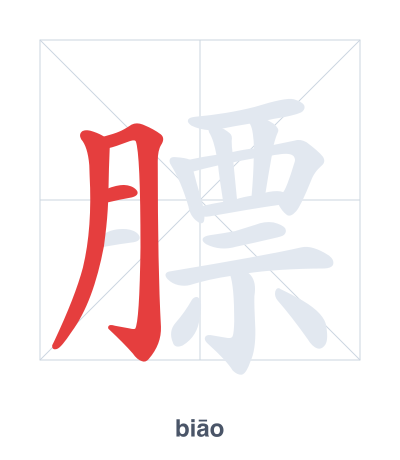
Open Hanzi Writer to see the animated stroke order and practice writing 膘 with real-time feedback.
The character 膘 (biāo) is written with 15 strokes. Follow the standard Chinese stroke order: top to bottom, left to right, outside before inside. The radical 月 is one of its key components.
Practice the correct stroke order with the Hanzi Writer app to see animated stroke-by-stroke guidance with real-time feedback.
膘 means fat (of animals); blubber.
膘 is a phono-semantic compound. The radical 月 (flesh) indicates it relates to animal body parts, while the component 票 (piào) provides the pronunciation. Together, they denote the layer of fat or blubber in animals.
💡 Memory Tip: Imagine a ticket (票) made of greasy meat (月) that's so thick it's pure animal blubber.
这块肉肥膘很多。
zhè kuài ròu féi biāo hěn duō
This meat has a lot of fat.
秋天要贴秋膘。
qiū tiān yào tiē qiū biāo
In autumn, one should eat well to gain weight for winter.
牛的膘情很好。
niú de biāo qíng hěn hǎo
The cattle are in good condition.
Open Hanzi Writer to see the animated stroke order and practice writing 膘 with real-time feedback.
✨ Animated stroke order · Handwriting recognition · HSK-graded practice · Free to use
膘 is made of the radical 月 (meat/flesh) on the left and the character 票 (piào) on the right. The 月 radical connects the character to animal body parts or meat, while 票 gives the sound. Together they mean "fat" or "blubber" in animals.