阻 (zǔ) means "to block; to hinder" in Chinese. It has 7 strokes with the radical 阝, and is HSK Level 4.
Rated 3.2/5 in difficulty (challenging).
Harder than 24% of HSK Level 4 characters.
Appears in 3+ common words including 阻止 (zǔ zhǐ), 阻碍 (zǔ ài), 阻力 (zǔ lì).
Due to its 7 strokes, Hanzi Writer's error detection shows 阻 requires focused practice — most learners need 10+ attempts for consistent accuracy.
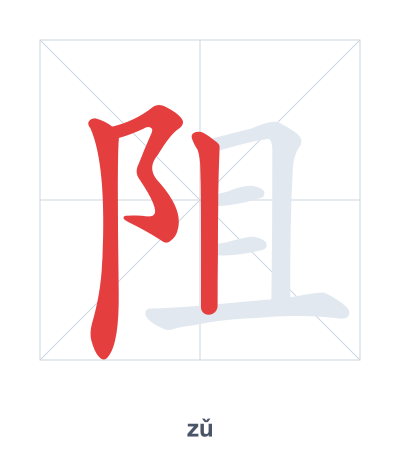
Open Hanzi Writer to see the animated stroke order and practice writing 阻 with real-time feedback.
The character 阻 (zǔ) is written with 7 strokes. Follow the standard Chinese stroke order: top to bottom, left to right, outside before inside. The radical 阝 is one of its key components.
Practice the correct stroke order with the Hanzi Writer app to see animated stroke-by-stroke guidance with real-time feedback.
阻 means to block; to hinder.
As an HSK Level 4 character, 阻 is an intermediate-level character.
The character 阻 combines the radical 阝 (a hill or mound) with the phonetic component 且 (pronounced zǔ). Hills naturally block movement, so the compound conveys the idea of obstructing or hindering.
💡 Memory Tip: Picture a heavy table (且) shoved against a hill (阝) to block the road.
没人能阻止他离开。
méi rén néng zǔ zhǐ tā lí kāi
No one can stop him from leaving.
困难阻碍了进步。
kùn nán zǔ ài le jìn bù
Difficulties hindered progress.
这里的阻力很大。
zhè lǐ de zǔ lì hěn dà
The resistance here is very great.
Open Hanzi Writer to see the animated stroke order and practice writing 阻 with real-time feedback.
✨ Animated stroke order · Handwriting recognition · HSK-graded practice · Free to use
阻 combines the radical 阝 (representing a hill or mound) on the left with 且 (a pictograph of an ancestral altar) on the right. The hill suggests a physical obstacle, while 且 adds the idea of a barrier, together creating the meaning "to block" or "to hinder."