够 (gòu) means "Enough" in Chinese. It has 11 strokes with the radical 夕, and is HSK Level 2.
Rated 3/5 in difficulty (moderate).
Harder than 42% of HSK Level 2 characters.
Appears in 3+ common words including 足够 (zú gòu), 能够 (néng gòu), 不够 (bù gòu).
Hanzi Writer's stroke validation shows learners typically need 5-8 attempts to write 够 with correct proportion and order.
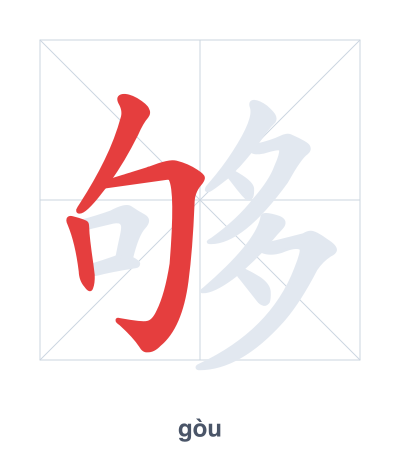
Open Hanzi Writer to see the animated stroke order and practice writing 够 with real-time feedback.
The character 够 (gòu) is written with 11 strokes. Follow the standard Chinese stroke order: top to bottom, left to right, outside before inside. The radical 夕 is one of its key components.
Practice the correct stroke order with the Hanzi Writer app to see animated stroke-by-stroke guidance with real-time feedback.
够 means Enough.
As an HSK Level 2 character, 够 is among the first characters beginners learn.
够 combines 句 (sentence/hook) and 多 (many). Having many hooks or sentences implies having enough of something. The radical 夕 (evening) hints at the phonetic aspect, not the meaning.
💡 Memory Tip: Picture a fisherman with many (多) hooks (句) on his line, catching enough fish for dinner.
这里的食物足够了。
zhè lǐ de shí wù zú gòu le
There is enough food here.
我能够完成这个任务。
wǒ néng gòu wán chéng zhè ge rèn wù
I can complete this task.
我的钱好像不够。
wǒ de qián hǎo xiàng bù gòu
It seems I don't have enough money.
Open Hanzi Writer to see the animated stroke order and practice writing 够 with real-time feedback.
✨ Animated stroke order · Handwriting recognition · HSK-graded practice · Free to use
够 is made of two parts: on the left is 句 (sentence) and on the right is 多 (many). Together, they suggest having 'many sentences' or enough of something. The radical 夕 appears inside 多, which uses two 夕 (evening) to show abundance.