壮 (zhuàng) means "Strong; robust; magnificent." in Chinese. It has 6 strokes with the radical 士, and is HSK Level 6.
Rated 3.2/5 in difficulty (challenging).
Harder than 10% of HSK Level 6 characters.
Appears in 3+ common words including 强壮 (qiáng zhuàng), 壮观 (zhuàng guān), 壮大 (zhuàng dà).
Due to its 6 strokes, Hanzi Writer's error detection shows 壮 requires focused practice — most learners need 10+ attempts for consistent accuracy.
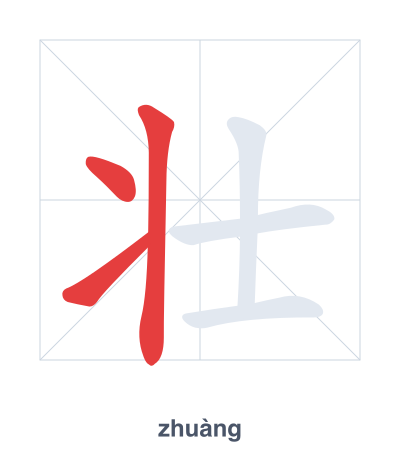
Open Hanzi Writer to see the animated stroke order and practice writing 壮 with real-time feedback.
The character 壮 (zhuàng) is written with 6 strokes. Follow the standard Chinese stroke order: top to bottom, left to right, outside before inside. The radical 士 is one of its key components.
Practice the correct stroke order with the Hanzi Writer app to see animated stroke-by-stroke guidance with real-time feedback.
壮 means Strong; robust; magnificent..
As an HSK Level 6 character, 壮 is an intermediate-level character.
The character 壮 combines 士 (a man or scholar) with 丬 (a variant of 爿, meaning a bed or plank). Together, they depict a man strong enough to carry a heavy plank, symbolizing robustness and strength.
💡 Memory Tip: Imagine a strong man (士) lifting a heavy bed (丬) to show his magnificent strength.
他的身体很强壮。
tā de shēn tǐ hěn qiáng zhuàng
His body is very strong.
长城非常壮观。
cháng chéng fēi cháng zhuàng guān
The Great Wall is very magnificent.
公司正在壮大。
gōng sī zhèng zài zhuàng dà
The company is growing stronger.
Open Hanzi Writer to see the animated stroke order and practice writing 壮 with real-time feedback.
✨ Animated stroke order · Handwriting recognition · HSK-graded practice · Free to use
The character 壮 consists of the radical 士 (scholar or warrior) on the left and the component 丬 on the right. The 士 suggests a person, while 丬 originally meant a bed board and gives a hint to the pronunciation. Together they create the image of a strong warrior, matching the meaning of 'strong' or 'robust'.