驻 (zhù) means "to stay; to be stationed" in Chinese. It has 8 strokes with the radical 马, and is HSK Level 6.
Rated 3.7/5 in difficulty (challenging).
Harder than 36% of HSK Level 6 characters.
Appears in 3+ common words including 驻华 (zhù huá), 驻扎 (zhù zhā), 驻地 (zhù dì).
Due to its 8 strokes, Hanzi Writer's error detection shows 驻 requires focused practice — most learners need 10+ attempts for consistent accuracy.
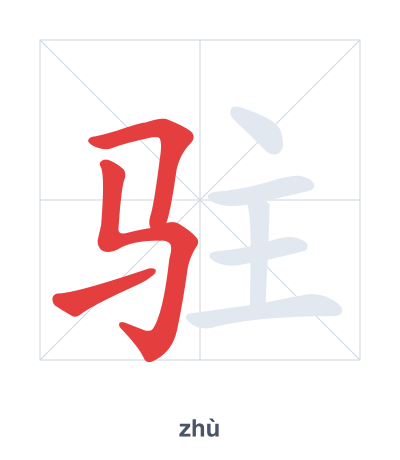
Open Hanzi Writer to see the animated stroke order and practice writing 驻 with real-time feedback.
The character 驻 (zhù) is written with 8 strokes. Follow the standard Chinese stroke order: top to bottom, left to right, outside before inside. The radical 马 is one of its key components.
Practice the correct stroke order with the Hanzi Writer app to see animated stroke-by-stroke guidance with real-time feedback.
驻 means to stay; to be stationed.
As an HSK Level 6 character, 驻 is an intermediate-level character.
驻 is a phono-semantic compound. The radical 马 (horse) hints at travel or movement, while 主 (zhǔ, 'master' or 'host') provides the pronunciation and suggests a sense of settling or staying under a master's command. Together, they convey the idea of a horse (or army) being stationed at a place.
💡 Memory Tip: Imagine a horse (马) standing guard at a master's (主) post, refusing to leave—it stays and is stationed there.
他是驻华大使。
tā shì zhù huá dà shǐ
He is the ambassador to China.
军队在山下驻扎。
jūn duì zài shān xià zhù zhā
The army is stationed at the foot of the mountain.
这里是我们的驻地。
zhè lǐ shì wǒ men de zhù dì
This is our base.
Open Hanzi Writer to see the animated stroke order and practice writing 驻 with real-time feedback.
✨ Animated stroke order · Handwriting recognition · HSK-graded practice · Free to use
The character 驻 is made of two parts: the left radical 马 (horse) and the right component 主 (main or host). The horse radical suggests movement or cavalry, and 主 adds the idea of a main place or staying. Together they imply a horse staying at a main location, which leads to the meaning of 'to stay' or 'to be stationed.'