箸 (zhù) means "chopsticks (literary)" in Chinese. It has 14 strokes with the radical 竹.
Rated 4.2/5 in difficulty (advanced).
Appears in 3+ common words including 箸子 (zhù zi), 举箸 (jǔ zhù), 象箸 (xiàng zhù).
Due to its 14 strokes, Hanzi Writer's error detection shows 箸 requires focused practice — most learners need 10+ attempts for consistent accuracy.
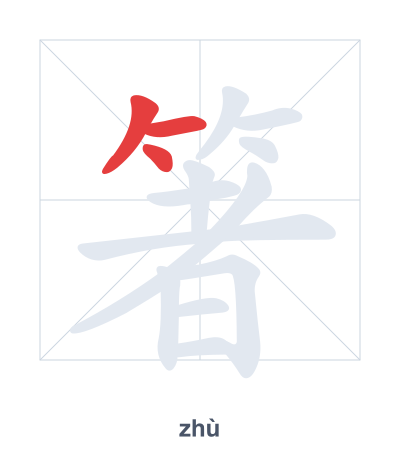
Open Hanzi Writer to see the animated stroke order and practice writing 箸 with real-time feedback.
The character 箸 (zhù) is written with 14 strokes. Follow the standard Chinese stroke order: top to bottom, left to right, outside before inside. The radical 竹 is one of its key components.
Practice the correct stroke order with the Hanzi Writer app to see animated stroke-by-stroke guidance with real-time feedback.
箸 means chopsticks (literary).
箸 combines the radical ⺮ (bamboo, suggesting the material) with 者 (person, which also provides the pronunciation). This compound literally depicts 'bamboo that which [holds food]'—a naturally fitting description for chopsticks, which were historically crafted from bamboo.
💡 Memory Tip: Picture a pair of bamboo sticks (⺮) held by a person (者) to elegantly pick up a single grain of rice.
他拿着箸子。
tā ná zhe zhù zi
He was holding chopsticks.
大家请举箸。
dà jiā qǐng jǔ zhù
Everyone, please pick up your chopsticks.
这是一双象箸。
zhè shì yī shuāng xiàng zhù
This is a pair of ivory chopsticks.
Open Hanzi Writer to see the animated stroke order and practice writing 箸 with real-time feedback.
✨ Animated stroke order · Handwriting recognition · HSK-graded practice · Free to use
箸 is made of the radical 竹 (bamboo) on top and the phonetic component 者 (zhě) below. The bamboo radical indicates that chopsticks are traditionally made from bamboo, while 者 gives the character its pronunciation. Together, they form a character that means 'chopsticks.'