筊 (xiáo) means "Bamboo slips used for divination" in Chinese. It has 12 strokes with the radical 竹.
Rated 4.2/5 in difficulty (advanced).
Appears in 3+ common words including 筊杯 (xiáo bēi), 掷筊 (zhì xiáo), 圣筊 (shèng xiáo).
Due to its 12 strokes, Hanzi Writer's error detection shows 筊 requires focused practice — most learners need 10+ attempts for consistent accuracy.
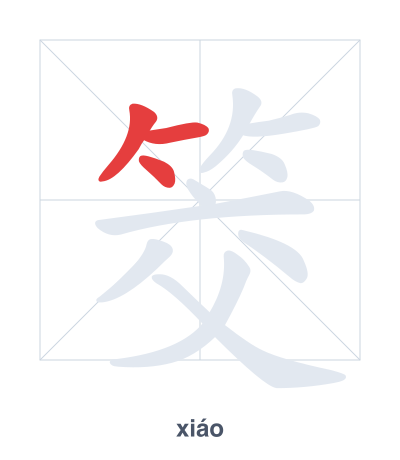
Open Hanzi Writer to see the animated stroke order and practice writing 筊 with real-time feedback.
The character 筊 (xiáo) is written with 12 strokes. Follow the standard Chinese stroke order: top to bottom, left to right, outside before inside. The radical 竹 is one of its key components.
Practice the correct stroke order with the Hanzi Writer app to see animated stroke-by-stroke guidance with real-time feedback.
筊 means Bamboo slips used for divination.
筊 combines the bamboo radical 竹 with 交 (to cross, intersect). In ancient Chinese divination, crossed bamboo slips were tossed to produce random patterns for oracular readings.
💡 Memory Tip: Picture two bamboo slips (竹) crossed (交) like an 'X' in the air as a diviner tosses them to predict your fortune.
他在庙里掷筊杯。
tā zài miào lǐ zhì xiáo bēi
He is throwing divination blocks in the temple.
掷筊是一种传统习俗。
zhì xiáo shì yī zhǒng chuán tǒng xí sú
Throwing moon blocks is a traditional custom.
他得到了一个圣筊。
tā dé dào le yí gè shèng xiáo
He received a divine sign (Sheng Jiao).
Open Hanzi Writer to see the animated stroke order and practice writing 筊 with real-time feedback.
✨ Animated stroke order · Handwriting recognition · HSK-graded practice · Free to use
筊 is composed of two parts: the radical 竹 (bamboo) on top, and the phonetic component 爻 (yáo) below. The bamboo radical indicates the character relates to bamboo objects, while 爻 originally meant 'to cross' or 'divination lines' in the I Ching. Together, they form the idea of bamboo slips used for divination.