象 (xiàng) means "Elephant" in Chinese. It has 11 strokes with the radical 豕, and is HSK Level 3.
Rated 4.2/5 in difficulty (advanced).
Harder than 95% of HSK Level 3 characters.
Appears in 3+ common words including 大象 (dà xiàng), 现象 (xiàn xiàng), 印象 (yìn xiàng).
Due to its 11 strokes, Hanzi Writer's error detection shows 象 requires focused practice — most learners need 10+ attempts for consistent accuracy.
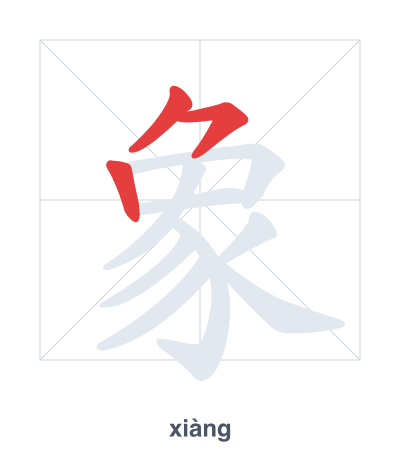
Open Hanzi Writer to see the animated stroke order and practice writing 象 with real-time feedback.
The character 象 (xiàng) is written with 11 strokes. Follow the standard Chinese stroke order: top to bottom, left to right, outside before inside. The radical 豕 is one of its key components.
Practice the correct stroke order with the Hanzi Writer app to see animated stroke-by-stroke guidance with real-time feedback.
象 means Elephant.
As an HSK Level 3 character, 象 is an intermediate-level character.
象 is a pictograph of an elephant. The ancient oracle bone script depicted a side view of the animal with a long trunk, large ears, and sturdy legs. Over time, the shape simplified to the current form, where the top part (⺈) represents the trunk and ears, and the bottom (豕) the body.
💡 Memory Tip: Picture the top stroke as a curved elephant trunk reaching down for a peanut, with the rest of the character as its big round body and swinging tail.
大象的鼻子很长。
dà xiàng de bí zi hěn zhǎng
The elephant's trunk is very long.
这是一个自然现象。
zhè shì yí gè zì rán xiàn xiàng
This is a natural phenomenon.
你对他的印象好吗?
nǐ duì tā de yìn xiàng hǎo ma
Do you have a good impression of him?
Open Hanzi Writer to see the animated stroke order and practice writing 象 with real-time feedback.
✨ Animated stroke order · Handwriting recognition · HSK-graded practice · Free to use
The character 象 is a pictograph that depicts an elephant. The top part represents the elephant's trunk and head, while the bottom part (which looks like 豕, the pig radical) represents the elephant's body and legs.