踵 (zhǒng) means "heel; to follow" in Chinese. It has 16 strokes with the radical 足.
Rated 4.2/5 in difficulty (advanced).
Appears in 3+ common words including 接踵而至 (jiē zhǒng ér zhì), 摩肩接踵 (mó jiān jiē zhǒng), 接踵 (jiē zhǒng).
Due to its 16 strokes, Hanzi Writer's error detection shows 踵 requires focused practice — most learners need 10+ attempts for consistent accuracy.
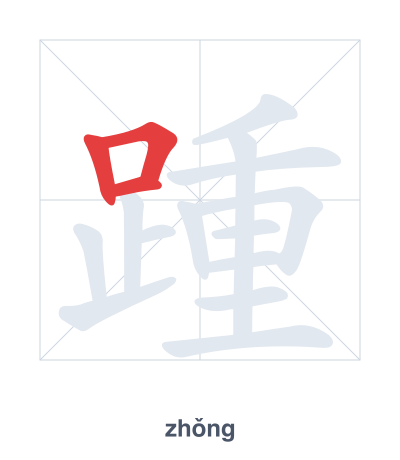
Open Hanzi Writer to see the animated stroke order and practice writing 踵 with real-time feedback.
The character 踵 (zhǒng) is written with 16 strokes. Follow the standard Chinese stroke order: top to bottom, left to right, outside before inside. The radical 足 is one of its key components.
Practice the correct stroke order with the Hanzi Writer app to see animated stroke-by-stroke guidance with real-time feedback.
踵 means heel; to follow.
The character 踵 is a compound with the radical 足 (foot) on the left and the phonetic component 重 (zhòng, meaning heavy or to repeat) on the right. The heel is the heavy, weight-bearing part of the foot, and the extended meaning 'to follow' comes from the idea of stepping after someone, as a repeated, weighted motion.
💡 Memory Tip: Picture a heavy weight (重) stuck to your heel (足), forcing you to follow behind others slowly.
好消息接踵而至。
hǎo xiāo xī jiē zhǒng ér zhì
Good news came one after another.
街上摩肩接踵。
jiē shàng mó jiān jiē zhǒng
The street is crowded with people.
游客们接踵而来。
yóu kè men jiē zhǒng ér lái
Tourists are coming in quick succession.
Open Hanzi Writer to see the animated stroke order and practice writing 踵 with real-time feedback.
✨ Animated stroke order · Handwriting recognition · HSK-graded practice · Free to use
踵 is composed of the radical 足 (foot) on the left and the phonetic component 重 (zhòng/zhǒng) on the right. The radical 足 indicates the character relates to the foot, while 重 gives a clue to the pronunciation zhǒng and the idea of "following" or "pressing" (as in one step after another). Together, they create the meaning "heel" (the back part of the foot) and "to follow."