螽 (zhōng) means "katydid / long-horned grasshopper" in Chinese. It has 17 strokes with the radical 虫.
Rated 4.2/5 in difficulty (advanced).
Appears in 3+ common words including 螽斯 (zhōng sī), 鸣螽 (míng zhōng), 捉螽斯 (zhuō zhōng sī).
Due to its 17 strokes, Hanzi Writer's error detection shows 螽 requires focused practice — most learners need 10+ attempts for consistent accuracy.
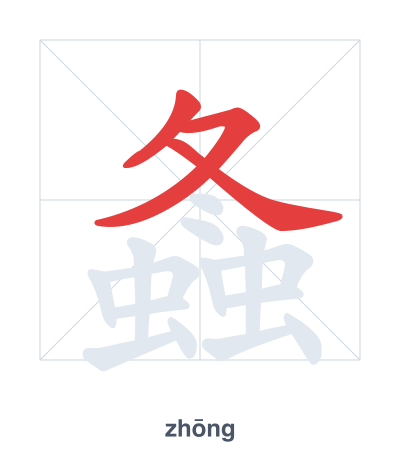
Open Hanzi Writer to see the animated stroke order and practice writing 螽 with real-time feedback.
The character 螽 (zhōng) is written with 17 strokes. Follow the standard Chinese stroke order: top to bottom, left to right, outside before inside. The radical 虫 is one of its key components.
Practice the correct stroke order with the Hanzi Writer app to see animated stroke-by-stroke guidance with real-time feedback.
螽 means katydid / long-horned grasshopper.
螽 is a phono-semantic compound: the radical 虫 (insect) indicates the meaning, while the upper component 冬 (winter, originally depicting a knotted cord) provides a phonetic clue, though the pronunciation shifted from dōng to zhōng.
💡 Memory Tip: Picture a katydid (虫) shivering in the snowflakes of winter (冬) because its long horns can't fit under a scarf.
螽斯在草丛里。
zhōng sī zài cǎo cóng lǐ
The katydid is in the grass.
螽斯的叫声好听。
zhōng sī de jiào shēng hǎo tīng
The katydid's chirp sounds pleasant.
他在捉螽斯。
tā zài zhuō zhōng sī
He is catching a katydid.
Open Hanzi Writer to see the animated stroke order and practice writing 螽 with real-time feedback.
✨ Animated stroke order · Handwriting recognition · HSK-graded practice · Free to use
螽 is made of the radical 虫 (insect) on the bottom and the component 冬 (winter) on the top. The 虫 radical tells you it is an insect, while 冬 may hint that katydids are often heard chirping in late summer and fall, leading into winter.