蝌 (kē) means "Tadpole (character component)" in Chinese. It has 15 strokes with the radical 虫.
Rated 4.2/5 in difficulty (advanced).
Appears in 3+ common words including 蝌蚪 (kē dǒu), 小蝌蚪 (xiǎo kē dǒu), 捉蝌蚪 (zhuō kē dǒu).
Due to its 15 strokes, Hanzi Writer's error detection shows 蝌 requires focused practice — most learners need 10+ attempts for consistent accuracy.
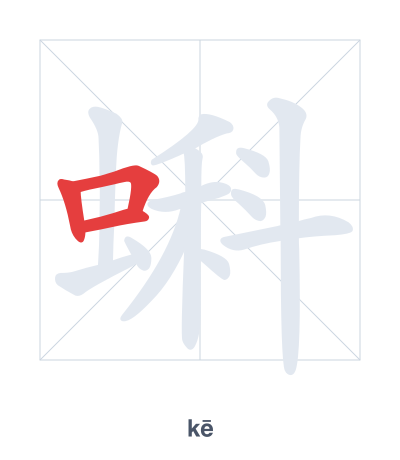
Open Hanzi Writer to see the animated stroke order and practice writing 蝌 with real-time feedback.
The character 蝌 (kē) is written with 15 strokes. Follow the standard Chinese stroke order: top to bottom, left to right, outside before inside. The radical 虫 is one of its key components.
Practice the correct stroke order with the Hanzi Writer app to see animated stroke-by-stroke guidance with real-time feedback.
蝌 means Tadpole (character component).
蝌 is a phono-semantic compound: the radical 虫 (insect/creature) hints at its biological nature as an aquatic animal, while 科 (kē) provides the pronunciation. It specifically refers to the tadpole stage of frogs and toads, often used in the compound 蝌蚪 (kēdǒu).
💡 Memory Tip: Imagine a tiny tadpole (虫) swimming under a microscope slide labeled '科' (Science subject), because studying tadpoles is a classic biology lesson.
池塘里有小蝌蚪。
chí táng lǐ yǒu xiǎo kē dǒu
There are small tadpoles in the pond.
蝌蚪长大会变成青蛙。
kē dǒu zhǎng dà huì biàn chéng qīng wā
Tadpoles grow up to become frogs.
孩子们在捉蝌蚪。
hái zi men zài zhuō kē dǒu
The children are catching tadpoles.
Open Hanzi Writer to see the animated stroke order and practice writing 蝌 with real-time feedback.
✨ Animated stroke order · Handwriting recognition · HSK-graded practice · Free to use
蝌 is made of the radical 虫 (insect or creature) on the left and the character 科 (kē, meaning branch or subject) on the right. The 虫 part shows that a tadpole is a small water creature, while 科 provides the sound kē and hints at the scientific classification of frogs.