蝎 (xiē) means "Scorpion (character component)" in Chinese. It has 15 strokes with the radical 虫.
Rated 4.2/5 in difficulty (advanced).
Appears in 3+ common words including 蝎子 (xiē zi), 毒蝎 (dú xiē), 蝎子蛰 (xiē zi zhé).
Due to its 15 strokes, Hanzi Writer's error detection shows 蝎 requires focused practice — most learners need 10+ attempts for consistent accuracy.
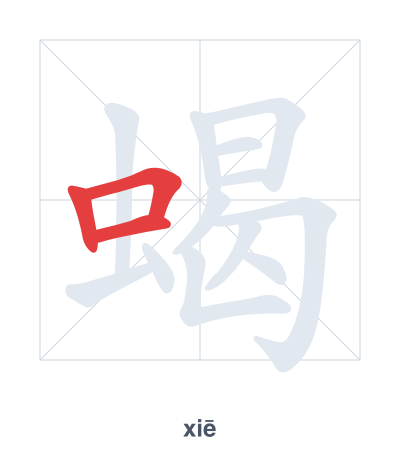
Open Hanzi Writer to see the animated stroke order and practice writing 蝎 with real-time feedback.
The character 蝎 (xiē) is written with 15 strokes. Follow the standard Chinese stroke order: top to bottom, left to right, outside before inside. The radical 虫 is one of its key components.
Practice the correct stroke order with the Hanzi Writer app to see animated stroke-by-stroke guidance with real-time feedback.
蝎 means Scorpion (character component).
蝎 is a phono-semantic compound where 虫 (insect/bug) indicates the creature is an arthropod, and 曷 (pronounced hé) provides the phonetic component xiē. The scorpion, though not an insect, is grouped under the insect radical due to its similar small crawling form.
💡 Memory Tip: The scorpion (虫) asks 'What?' (曷) before striking with its venomous tail.
沙漠里有蝎子。
shā mò lǐ yǒu xiē zi
There are scorpions in the desert.
蝎子的尾巴有毒。
xiē zi de wěi ba yǒu dú
A scorpion's tail is poisonous.
他被蝎子蛰了一下。
tā bèi xiē zi zhé le yī xià
He was stung by a scorpion.
Open Hanzi Writer to see the animated stroke order and practice writing 蝎 with real-time feedback.
✨ Animated stroke order · Handwriting recognition · HSK-graded practice · Free to use
蝎 is a phono-semantic compound. The left part 虫 (insect radical) indicates that the character refers to a creature, specifically a bug or arachnid. The right part 曷 provides the pronunciation clue (xiē) and does not directly contribute to the meaning.