蝓 (yú) means "Slug (character component)" in Chinese. It has 15 strokes with the radical 虫.
Rated 4.2/5 in difficulty (advanced).
Appears in 3+ common words including 蛞蝓 (kuò yú), 小蛞蝓 (xiǎo kuò yú), 蛞蝓爬 (kuò yú pá).
Due to its 15 strokes, Hanzi Writer's error detection shows 蝓 requires focused practice — most learners need 10+ attempts for consistent accuracy.
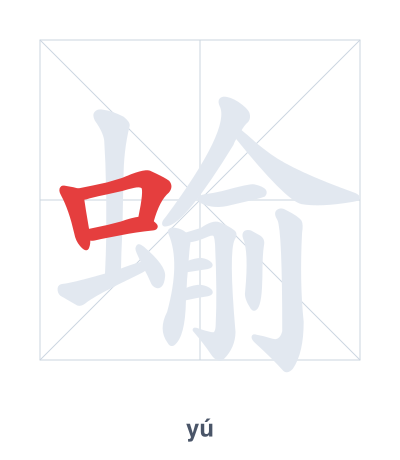
Open Hanzi Writer to see the animated stroke order and practice writing 蝓 with real-time feedback.
The character 蝓 (yú) is written with 15 strokes. Follow the standard Chinese stroke order: top to bottom, left to right, outside before inside. The radical 虫 is one of its key components.
Practice the correct stroke order with the Hanzi Writer app to see animated stroke-by-stroke guidance with real-time feedback.
蝓 means Slug (character component).
蝓 is composed of the radical 虫 (insect/worm) and the phonetic component 俞 (yú), which indicates its pronunciation. The radical suggests a creature related to insects or worms, and the overall character represents a slug, a slimy mollusk that crawls on the ground.
💡 Memory Tip: Imagine a slug (虫) sliding along a leaf, leaving a shiny trail, and it says 'yú' as it moves—this helps you remember both the shape and the sound.
蛞蝓在叶子上爬。
kuò yú zài yè zi shàng pá
The slug is crawling on the leaf.
雨后能看到蛞蝓。
yǔ hòu néng kàn dào kuò yú
Slugs can be seen after the rain.
蛞蝓长得像蜗牛。
kuò yú zhǎng dé xiàng wō niú
Slugs look like snails.
Open Hanzi Writer to see the animated stroke order and practice writing 蝓 with real-time feedback.
✨ Animated stroke order · Handwriting recognition · HSK-graded practice · Free to use
蝓 combines the radical 虫, which means 'insect' or 'worm,' with the phonetic component 俞, which gives the sound 'yú.' The radical indicates that the character refers to a small crawling creature, and in this case, it specifically denotes a slug. The structure is a classic example of a semantic-phonetic compound, where one part hints at the meaning and the other at the pronunciation.