踬 (zhì) means "to stumble; to trip" in Chinese. It has 15 strokes with the radical 足.
Rated 4.2/5 in difficulty (advanced).
Appears in 3+ common words including 踬倒 (zhì dào), 颠踬 (diān zhì), 踬仆 (zhì pū).
Due to its 15 strokes, Hanzi Writer's error detection shows 踬 requires focused practice — most learners need 10+ attempts for consistent accuracy.
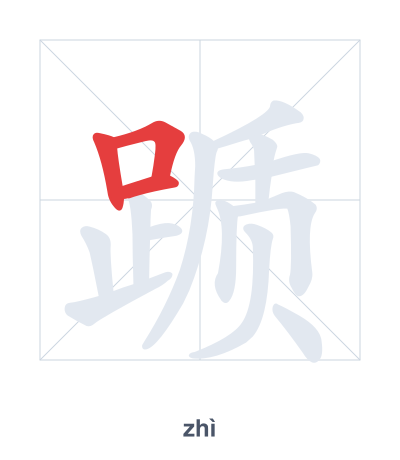
Open Hanzi Writer to see the animated stroke order and practice writing 踬 with real-time feedback.
The character 踬 (zhì) is written with 15 strokes. Follow the standard Chinese stroke order: top to bottom, left to right, outside before inside. The radical 足 is one of its key components.
Practice the correct stroke order with the Hanzi Writer app to see animated stroke-by-stroke guidance with real-time feedback.
踬 means to stumble; to trip.
This character is a phono-semantic compound. The left component 足 (foot) indicates the meaning relates to foot movement or walking. The right component 质 (zhì) provides the sound and also conveys the idea of 'substance' or 'obstacle', as stumbling involves the foot hitting an impediment.
💡 Memory Tip: Picture your foot (足) hitting a heavy block of 'quality' (质) and you stumble forward.
他被石头踬倒了。
tā bèi shí tou zhì dào le
He was tripped by a stone.
马车走得很颠踬。
mǎ chē zǒu dé hěn diān zhì
The carriage ride was very bumpy.
他在草地上踬仆。
tā zài cǎo dì shàng zhì pū
He stumbled and fell on the grass.
Open Hanzi Writer to see the animated stroke order and practice writing 踬 with real-time feedback.
✨ Animated stroke order · Handwriting recognition · HSK-graded practice · Free to use
踬 is composed of the radical 足 (foot) on the left and the phonetic component 质 (zhì) on the right. The radical 足 indicates that the meaning is related to foot actions, and the right part provides the sound. Together, they suggest the idea of a foot encountering an obstacle, leading to stumbling or tripping.