啧 (zé) means "To click one's tongue; tut-tut" in Chinese. It has 11 strokes with the radical 口.
Rated 4.2/5 in difficulty (advanced).
Appears in 3+ common words including 啧啧 (zé zé), 啧舌 (zé shé), 啧啧称奇 (zé zé chēng qí).
Due to its 11 strokes, Hanzi Writer's error detection shows 啧 requires focused practice — most learners need 10+ attempts for consistent accuracy.
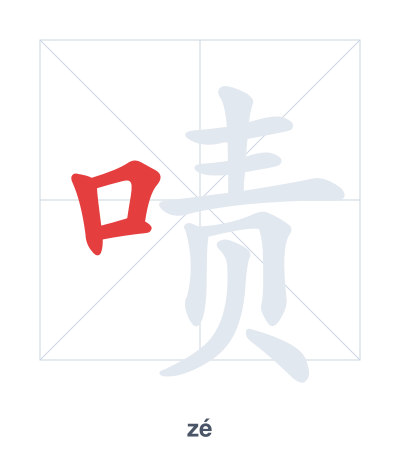
Open Hanzi Writer to see the animated stroke order and practice writing 啧 with real-time feedback.
The character 啧 (zé) is written with 11 strokes. Follow the standard Chinese stroke order: top to bottom, left to right, outside before inside. The radical 口 is one of its key components.
Practice the correct stroke order with the Hanzi Writer app to see animated stroke-by-stroke guidance with real-time feedback.
啧 means To click one's tongue; tut-tut.
啧 is a phono-semantic compound character. The radical 口 (mouth) indicates the action is performed with the mouth, while the phonetic component 責 (zé) originally means 'duty' or 'to reproach,' suggesting the disapproving sound of clicking one's tongue or tut-tutting.
💡 Memory Tip: Picture a stern mouth (口) that has the heavy responsibility (責) of scolding someone, so it clicks its tongue in a loud 'tsk-tsk' sound.
他啧啧称赞。
tā zé zé chēng zàn
He clicked his tongue in admiration.
令人啧舌的美景。
lìng rén zé shé de měi jǐng
A breathtaking view that leaves one speechless.
大家都啧啧称奇。
dà jiā dōu zé zé chēng qí
Everyone clicked their tongues in wonder.
Open Hanzi Writer to see the animated stroke order and practice writing 啧 with real-time feedback.
✨ Animated stroke order · Handwriting recognition · HSK-graded practice · Free to use
The character 啧 consists of the radical 口 (mouth) on the left, which directly connects to the sound or action of clicking the tongue. The right side is 責 (zé, meaning 'responsibility' or 'reproach'), which gives the character its sound and adds a sense of scolding or disapproval, matching the meaning of tut-tutting.