渔 (yú) means "To fish or fishing." in Chinese. It has 11 strokes with the radical 氵, and is HSK Level 7.
Rated 4.2/5 in difficulty (advanced).
Harder than 67% of HSK Level 7 characters.
Appears in 3+ common words including 渔民 (yú mín), 渔船 (yú chuán), 渔业 (yú yè).
Due to its 11 strokes, Hanzi Writer's error detection shows 渔 requires focused practice — most learners need 10+ attempts for consistent accuracy.
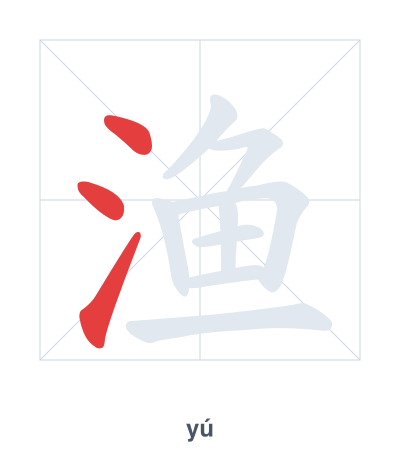
Open Hanzi Writer to see the animated stroke order and practice writing 渔 with real-time feedback.
The character 渔 (yú) is written with 11 strokes. Follow the standard Chinese stroke order: top to bottom, left to right, outside before inside. The radical 氵 is one of its key components.
Practice the correct stroke order with the Hanzi Writer app to see animated stroke-by-stroke guidance with real-time feedback.
渔 means To fish or fishing..
As an HSK Level 7 character, 渔 is an intermediate-level character.
This compound character combines the water radical 氵 (shuǐ, meaning water) with the phonetic component 鱼 (yú, meaning fish), visually depicting the act of catching fish in water. The original form shows a hand (or net) alongside fish in water, reinforcing the meaning of fishing.
💡 Memory Tip: Imagine a fisherman standing by the water (氵) and tossing a net to catch a big fish (鱼) — the whole scene creates 渔.
渔民在海上打鱼。
yú mín zài hǎi shàng dǎ yú
Fishermen are fishing at sea.
港口停着很多渔船。
gǎng kǒu tíng zhe hěn duō yú chuán
Many fishing boats are docked at the port.
这里渔业很发达。
zhè lǐ yú yè hěn fā dá
The fishing industry is very developed here.
Open Hanzi Writer to see the animated stroke order and practice writing 渔 with real-time feedback.
✨ Animated stroke order · Handwriting recognition · HSK-graded practice · Free to use
渔 is made of two parts: the radical 氵 (water) on the left, and 鱼 (fish) on the right. Together, water and fish suggest the action of catching fish, so the character means 'to fish' or 'fishing'.