营 (yíng) means "camp; to operate; to run" in Chinese. It has 11 strokes with the radical 艹, and is HSK Level 3.
Rated 4.2/5 in difficulty (advanced).
Harder than 92% of HSK Level 3 characters.
Appears in 3+ common words including 经营 (jīng yíng), 露营 (lù yíng), 营养 (yíng yǎng).
Due to its 11 strokes, Hanzi Writer's error detection shows 营 requires focused practice — most learners need 10+ attempts for consistent accuracy.
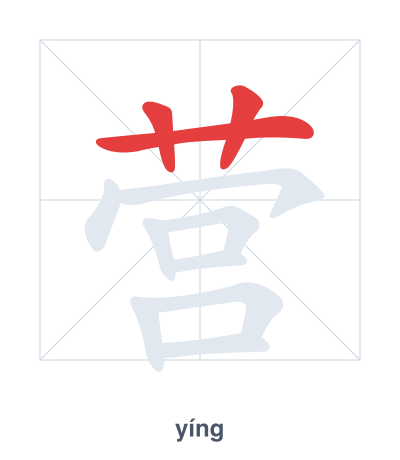
Open Hanzi Writer to see the animated stroke order and practice writing 营 with real-time feedback.
The character 营 (yíng) is written with 11 strokes. Follow the standard Chinese stroke order: top to bottom, left to right, outside before inside. The radical 艹 is one of its key components.
Practice the correct stroke order with the Hanzi Writer app to see animated stroke-by-stroke guidance with real-time feedback.
营 means camp; to operate; to run.
As an HSK Level 3 character, 营 is an intermediate-level character.
The character 营 originated as a compound combining 艹 (grass, suggesting thatch or tent material) with 冖 (a cover) and 吕 (two mouths or enclosures), together picturing a temporary shelter where people gather, hence 'camp'. In traditional form 營, it also included 荧 (firelight), evoking a lighted military encampment.
💡 Memory Tip: Picture a grassy (艹) camp where a cover (冖) shields two hungry mouths (吕) as they operate a kitchen.
他经营一家书店。
tā jīng yíng yī jiā shū diàn
He runs a bookstore.
我们周末去露营。
wǒ men zhōu mò qù lù yíng
We are going camping this weekend.
牛奶很有营养。
niú nǎi hěn yǒu yíng yǎng
Milk is very nutritious.
Open Hanzi Writer to see the animated stroke order and practice writing 营 with real-time feedback.
✨ Animated stroke order · Handwriting recognition · HSK-graded practice · Free to use
营 has three parts: the top is 艹 (grass), the middle is 冖 (a roof or cover), and the bottom is 吕 (two mouths). Together they suggest a shelter made of grass where people gather, relating to the meanings of "camp" and "operate" (like running a business out of a camp). The grass and roof imply a temporary structure, while the mouths suggest people or activities inside.