喑 (yīn) means "mute / silent" in Chinese. It has 12 strokes with the radical 口.
Rated 4.2/5 in difficulty (advanced).
Appears in 3+ common words including 喑哑 (yīn yǎ), 喑默 (yīn mò), 喑呜 (yīn wū).
Due to its 12 strokes, Hanzi Writer's error detection shows 喑 requires focused practice — most learners need 10+ attempts for consistent accuracy.
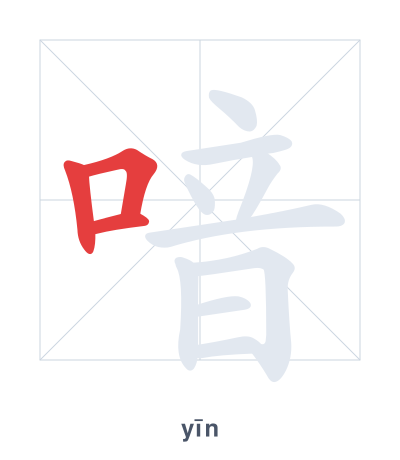
Open Hanzi Writer to see the animated stroke order and practice writing 喑 with real-time feedback.
The character 喑 (yīn) is written with 12 strokes. Follow the standard Chinese stroke order: top to bottom, left to right, outside before inside. The radical 口 is one of its key components.
Practice the correct stroke order with the Hanzi Writer app to see animated stroke-by-stroke guidance with real-time feedback.
喑 means mute / silent.
喑 combines the mouth radical (口) with the sound component 音 (yīn, 'sound'), suggesting that the mouth produces sound—yet the character paradoxically means 'mute' or 'silent', as if the sound is trapped or suppressed inside.
💡 Memory Tip: Picture a hand clamping over a mouth (口) that still tries to make a sound (音), leaving only a choked, silent cry.
他的嗓子喑哑了。
tā de sǎng zi yīn yǎ le
His voice has become hoarse.
他在角落里喑默不语。
tā zài jiǎo luò lǐ yīn mò bù yǔ
He is sitting silently in the corner.
听到这消息他喑呜不已。
tīng dào zhè xiāo xī tā yīn wū bù yǐ
He sobbed uncontrollably upon hearing the news.
Open Hanzi Writer to see the animated stroke order and practice writing 喑 with real-time feedback.
✨ Animated stroke order · Handwriting recognition · HSK-graded practice · Free to use
喑 is composed of the radical 口 (mouth) on the left and the phonetic component 音 (sound/voice) on the right. The combination suggests a mouth that should produce sound but is actually mute or silent, creating a contrast between the components and the character's meaning.