呜 (wū) means "hoot / hum / sob (onomatopoeia)" in Chinese. It has 7 strokes with the radical 口, and is HSK Level 7.
Rated 3.5/5 in difficulty (challenging).
Harder than 16% of HSK Level 7 characters.
Appears in 3+ common words including 呜呜 (wū wū), 呜咽 (wū yè), 呜 (wū).
Due to its 7 strokes, Hanzi Writer's error detection shows 呜 requires focused practice — most learners need 10+ attempts for consistent accuracy.
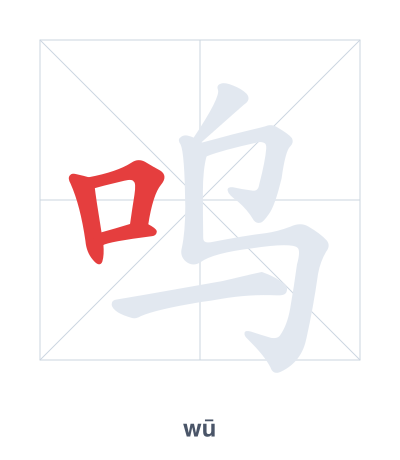
Open Hanzi Writer to see the animated stroke order and practice writing 呜 with real-time feedback.
The character 呜 (wū) is written with 7 strokes. Follow the standard Chinese stroke order: top to bottom, left to right, outside before inside. The radical 口 is one of its key components.
Practice the correct stroke order with the Hanzi Writer app to see animated stroke-by-stroke guidance with real-time feedback.
呜 means hoot / hum / sob (onomatopoeia).
As an HSK Level 7 character, 呜 is an intermediate-level character.
呜 is a phono-semantic compound combining the mouth radical 口 (indicating sound) with 乌 (wū, 'crow'), which provides both the pronunciation and a hint of the hooting or sobbing sound a crow makes. The character thus visually represents a mouth producing a crow-like 'wu' sound.
💡 Memory Tip: Picture a crow (乌) opening its beak (口) to let out a mournful "wu-wu" sob.
妹妹呜呜地哭了。
mèi mèi wū wū dì kū le
The younger sister sobbed and cried.
她小声地呜咽。
tā xiǎo shēng dì wū yè
She sobbed quietly.
火车呜地开了。
huǒ chē wū dì kāi le
The train started with a whistle.
Open Hanzi Writer to see the animated stroke order and practice writing 呜 with real-time feedback.
✨ Animated stroke order · Handwriting recognition · HSK-graded practice · Free to use
The character 呜 consists of the radical 口 (mouth) on the left and 乌 (wū, meaning 'crow' but acting as a phonetic component) on the right. The mouth radical indicates that the character represents a sound made by the mouth, while 乌 provides the pronunciation. Together, they form an onomatopoeia for hooting, humming, or sobbing noises.