酽 (yàn) means "strong (of tea or liquid)" in Chinese. It has 14 strokes with the radical 酉.
Rated 4.2/5 in difficulty (advanced).
Appears in 3+ common words including 酽茶 (yàn chá), 酽醋 (yàn cù), 酽酒 (yàn jiǔ).
Due to its 14 strokes, Hanzi Writer's error detection shows 酽 requires focused practice — most learners need 10+ attempts for consistent accuracy.
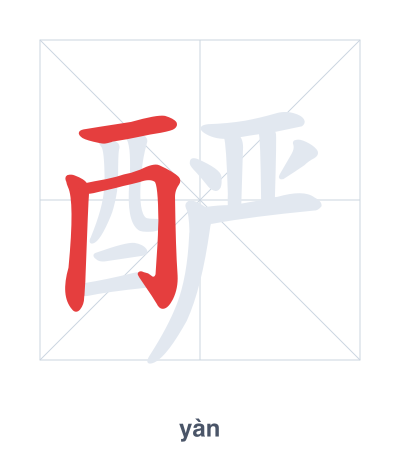
Open Hanzi Writer to see the animated stroke order and practice writing 酽 with real-time feedback.
The character 酽 (yàn) is written with 14 strokes. Follow the standard Chinese stroke order: top to bottom, left to right, outside before inside. The radical 酉 is one of its key components.
Practice the correct stroke order with the Hanzi Writer app to see animated stroke-by-stroke guidance with real-time feedback.
酽 means strong (of tea or liquid).
酽 is a compound character combining the radical 酉 (a wine jar, indicating liquid) with 嚴 (yán, meaning 'strict' or 'intense'). The 嚴 component contributes both the sound and the sense of strength or intensity, so together they depict a liquid—like tea or wine—that has been steeped or fermented to a strong, concentrated degree.
💡 Memory Tip: Imagine a strict (嚴) tea master pouring from an ancient wine jar (酉) a brew so dark and strong it looks like ink—that's 酽 tea.
爷爷喜欢喝酽茶。
yé yé xǐ huān hē yàn chá
Grandpa likes drinking strong tea.
这瓶酽醋很酸。
zhè píng yàn cù hěn suān
This bottle of strong vinegar is very sour.
这杯酽酒味道很重。
zhè bēi yàn jiǔ wèi dào hěn zhòng
This cup of strong liquor has a strong taste.
Open Hanzi Writer to see the animated stroke order and practice writing 酽 with real-time feedback.
✨ Animated stroke order · Handwriting recognition · HSK-graded practice · Free to use
The character 酽 is composed of the radical 酉 (yǒu), which relates to wine or fermentation, on the left, and the phonetic component 严 (yán, meaning strict) on the right. The 酉 radical suggests a liquid related to brewing, and 严 adds the idea of intensity or strength, together forming the meaning of a strong liquid like tea or vinegar.