Hanzi Writer

How to Write 酢 (cù) — Meaning “vinegar / to toast”

12 strokes Radical: 酉

酢 (cù) means "vinegar / to toast" in Chinese. It has 12 strokes with the radical 酉.

Rated 4.2/5 in difficulty (advanced).

Appears in 3+ common words including 酢浆草 (cù jiāng cǎo), 酬酢 (chóu cù), 酢菜 (cù cài).

Due to its 12 strokes, Hanzi Writer's error detection shows 酢 requires focused practice — most learners need 10+ attempts for consistent accuracy.
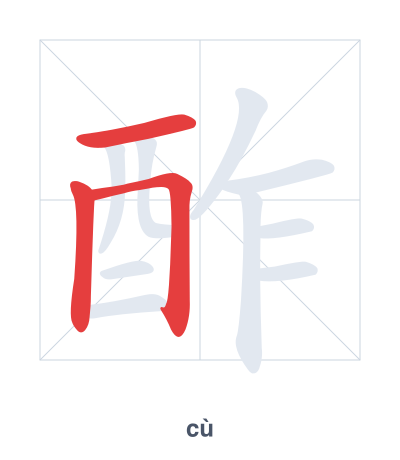
Stroke order practice for 酢 - cù

Practice Writing 酢 (cù)

Open Hanzi Writer to see the animated stroke order and practice writing 酢 with real-time feedback.

The character (cù) is written with 12 strokes. Follow the standard Chinese stroke order: top to bottom, left to right, outside before inside. The radical is one of its key components.

Practice the correct stroke order with the Hanzi Writer app to see animated stroke-by-stroke guidance with real-time feedback.

means vinegar / to toast.

Character
Pinyincù (cu)
Meaningvinegar / to toast
Strokes12
Radical
Difficulty4.2/5

酢 is a phono-semantic compound: the left radical 酉 depicts a wine jar or fermented liquid, linking to both 'vinegar' (a fermented condiment) and 'to toast' (drinking rite). The right component 乍 provides the sound (originally similar to cù) and subtly hints at 'first pressing' or 'sudden' tanginess.

💡 Memory Tip: Picture a wine jar (酉) suddenly (乍) splashing out sour vinegar—you toast with it but pucker your lips! (酢 = 酉 + 乍).

cù jiāng cǎo
wood sorrel / oxalis
chóu cù
to exchange toasts or socialize
cù cài
pickled vegetables

草地上有酢浆草。

cǎo dì shàng yǒu cù jiāng cǎo

There is wood sorrel on the grass.

社交场合需要酬酢。

shè jiāo chǎng hé xū yào chóu cù

Social occasions require social interaction.

这是一盘酢菜。

zhè shì yī pán cù cài

This is a plate of pickled vegetables.

Character Pinyin Strokes Radical
(current) 12
zhuó 10
pèi 10
zhòu 10
Stroke order practice for 酢 - cù

Practice Writing 酢 (cù)

Open Hanzi Writer to see the animated stroke order and practice writing 酢 with real-time feedback.

✨ Animated stroke order · Handwriting recognition · HSK-graded practice · Free to use

Frequently Asked Questions about 酢

酢 is made of the radical 酉 (wine jar) on the left and the component 乍 on the right. The 酉 radical connects the character to fermented drinks like vinegar, while 乍 originally helped with pronunciation (though modern pinyin is cù, not zhà). Together, they form the meaning of vinegar or the act of toasting.

Characters with Radical 酉

Other 12-Stroke Characters