酡 (tuó) means "flushed with wine / red-faced" in Chinese. It has 12 strokes with the radical 酉.
Rated 4.2/5 in difficulty (advanced).
Appears in 3+ common words including 酡红 (tuó hóng), 酡颜 (tuó yán), 醉酡 (zuì tuó).
Due to its 12 strokes, Hanzi Writer's error detection shows 酡 requires focused practice — most learners need 10+ attempts for consistent accuracy.
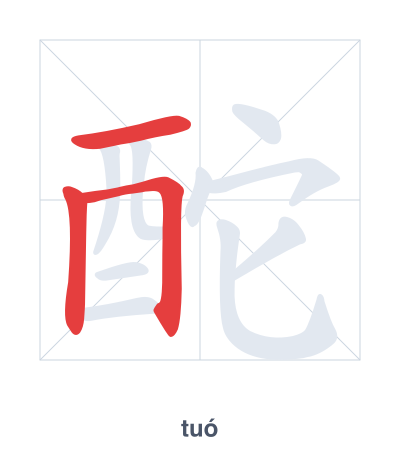
Open Hanzi Writer to see the animated stroke order and practice writing 酡 with real-time feedback.
The character 酡 (tuó) is written with 12 strokes. Follow the standard Chinese stroke order: top to bottom, left to right, outside before inside. The radical 酉 is one of its key components.
Practice the correct stroke order with the Hanzi Writer app to see animated stroke-by-stroke guidance with real-time feedback.
酡 means flushed with wine / red-faced.
The character 酡 is a phono-semantic compound where 酉 (wine vessel) indicates the connection to alcohol, and 它 (tuō) provides the pronunciation. Together, they depict the flushed, red face that comes from drinking wine.
💡 Memory Tip: Picture a wine jar (酉) with a big red 'O' face (like the mouth of 它) blushing after too much drink.
她的脸颊微带酡红。
tā de liǎn jiá wēi dài tuó hóng
Her cheeks were slightly flushed.
醉后满脸酡颜。
zuì hòu mǎn liǎn tuó yán
The face becomes flushed after getting drunk.
他喝得两腮醉酡。
tā hē dé liǎng sāi zuì tuó
His cheeks were flushed with wine.
Open Hanzi Writer to see the animated stroke order and practice writing 酡 with real-time feedback.
✨ Animated stroke order · Handwriting recognition · HSK-graded practice · Free to use
酡 is composed of the radical 酉 (wine/alcohol) on the left and 它 (tuō, meaning "other" or a phonetic component) on the right. The 酉 radical suggests a connection to drinking, while 它 provides the pronunciation tuó. Together, they create the idea of a person who has been drinking, resulting in a flushed face.