淹 (yān) means "to flood; to submerge; to drown" in Chinese. It has 11 strokes with the radical 氵, and is HSK Level 7.
Rated 4.2/5 in difficulty (advanced).
Harder than 67% of HSK Level 7 characters.
Appears in 3+ common words including 淹没 (yān mò), 淹死 (yān sǐ), 淹水 (yān shuǐ).
Due to its 11 strokes, Hanzi Writer's error detection shows 淹 requires focused practice — most learners need 10+ attempts for consistent accuracy.
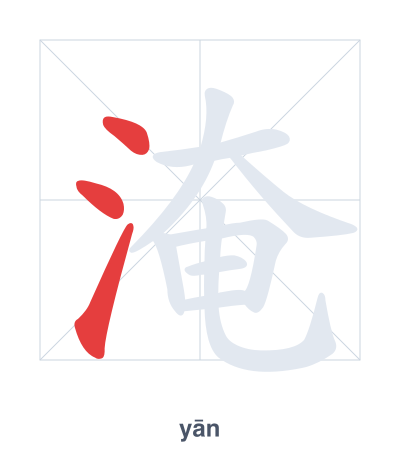
Open Hanzi Writer to see the animated stroke order and practice writing 淹 with real-time feedback.
The character 淹 (yān) is written with 11 strokes. Follow the standard Chinese stroke order: top to bottom, left to right, outside before inside. The radical 氵 is one of its key components.
Practice the correct stroke order with the Hanzi Writer app to see animated stroke-by-stroke guidance with real-time feedback.
淹 means to flood; to submerge; to drown.
As an HSK Level 7 character, 淹 is an intermediate-level character.
淹 combines the water radical 氵 with 奄 (yǎn), which originally meant 'to cover' or 'to have power over.' Water covering an area or overwhelming it gives the sense of flooding, submerging, or drowning.
💡 Memory Tip: Imagine a giant water wave (氵) crashing over and covering a big electric blanket (奄) that's lying on the ground, flooding everything.
洪水淹没了街道。
hóng shuǐ yān mò le jiē dào
The flood submerged the streets.
小心别在河里淹死。
xiǎo xīn bié zài hé lǐ yān sǐ
Be careful not to drown in the river.
这里的地下室淹水了。
zhè lǐ de dì xià shì yān shuǐ le
The basement here is flooded.
Open Hanzi Writer to see the animated stroke order and practice writing 淹 with real-time feedback.
✨ Animated stroke order · Handwriting recognition · HSK-graded practice · Free to use
淹 has the water radical 氵 on the left, and 奄 on the right. 奄 means 'to cover' or 'to conceal,' so together they show water covering something, which leads to the meanings of flood, submerge, or drown.