呀 (ya/yā) means "ah; oh (particle expressing surprise or softening a tone)" in Chinese. It has 7 strokes with the radical 口, and is HSK Level 4.
Rated 3.5/5 in difficulty (challenging).
Harder than 30% of HSK Level 4 characters.
Appears in 3+ common words including 好呀 (hǎo ya), 是呀 (shì ya), 哎呀 (āi yā).
Due to its 7 strokes, Hanzi Writer's error detection shows 呀 requires focused practice — most learners need 10+ attempts for consistent accuracy.
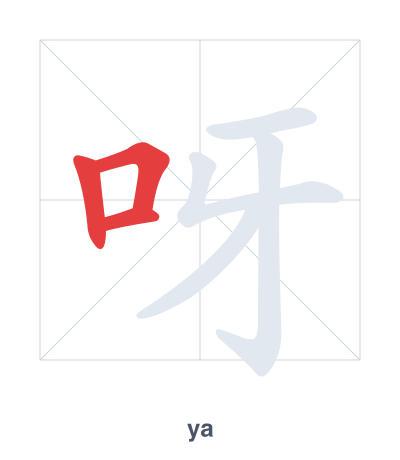
Open Hanzi Writer to see the animated stroke order and practice writing 呀 with real-time feedback.
The character 呀 (ya/yā) is written with 7 strokes. Follow the standard Chinese stroke order: top to bottom, left to right, outside before inside. The radical 口 is one of its key components.
Practice the correct stroke order with the Hanzi Writer app to see animated stroke-by-stroke guidance with real-time feedback.
呀 means ah; oh (particle expressing surprise or softening a tone).
This is a polyphonic character with readings: ya, yā.
As an HSK Level 4 character, 呀 is an intermediate-level character.
呀 combines the mouth radical 口 with 牙 (yá, 'tooth/fang') as the phonetic component. The mouth radical indicates a vocal sound, while the phonetic hints at the pronunciation. Together, they represent an exclamation like 'ah' or 'oh' that naturally opens the mouth, revealing the teeth.
💡 Memory Tip: Picture someone suddenly surprised, opening their mouth wide enough to show their teeth (牙) while shouting 'Ya!'
我们明天去玩好呀。
wǒ men míng tiān qù wán hǎo ya
Let's go out and have fun tomorrow.
是呀,天气真不错。
shì ya tiān qì zhēn bù cuò
Yes, the weather is really nice.
哎呀,我忘带钥匙了。
āi yā wǒ wàng dài yào shi le
Oh no, I forgot my keys.
Open Hanzi Writer to see the animated stroke order and practice writing 呀 with real-time feedback.
✨ Animated stroke order · Handwriting recognition · HSK-graded practice · Free to use
呀 is formed by the radical 口 (mouth) on the left and 牙 (tooth, pronounced ya) on the right. The mouth radical indicates that the character relates to sound or speech, while 牙 provides the pronunciation and hints at the exclamation sound, making it a phonetic compound.