良 (liáng) means "Good / Fine" in Chinese. It has 7 strokes with the radical 艮, and is HSK Level 4.
Rated 3.5/5 in difficulty (challenging).
Harder than 36% of HSK Level 4 characters.
Appears in 3+ common words including 良好 (liáng hǎo), 善良 (shàn liáng), 优良 (yōu liáng).
Due to its 7 strokes, Hanzi Writer's error detection shows 良 requires focused practice — most learners need 10+ attempts for consistent accuracy.
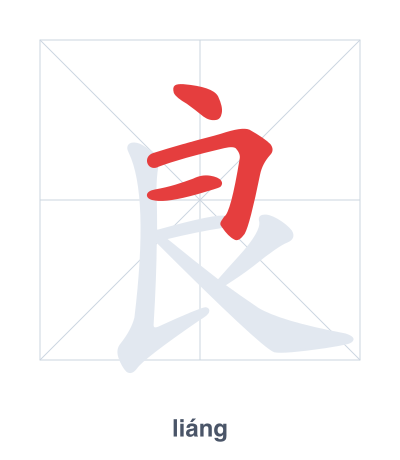
Open Hanzi Writer to see the animated stroke order and practice writing 良 with real-time feedback.
The character 良 (liáng) is written with 7 strokes. Follow the standard Chinese stroke order: top to bottom, left to right, outside before inside. The radical 艮 is one of its key components.
Practice the correct stroke order with the Hanzi Writer app to see animated stroke-by-stroke guidance with real-time feedback.
良 means Good / Fine.
As an HSK Level 4 character, 良 is an intermediate-level character.
In ancient oracle bone script, 良 was a pictograph of a covered corridor or passageway inside a house, suggesting a spacious and pleasant space, which led to the meaning 'good' or 'fine.' Over time, the form simplified to the modern character with the radical 艮 as its base.
💡 Memory Tip: Picture a top dot as a shining star above the sturdy shape 艮 (which looks like a firm 'good' foundation) — that star marks something as fine.
他的学习成绩良好。
tā de xué xí chéng jì liáng hǎo
His academic performance is good.
她是一个善良的人。
tā shì yí gè shàn liáng de rén
She is a kind person.
这里的品种优良。
zhè lǐ de pǐn zhǒng yōu liáng
The varieties here are of excellent quality.
Open Hanzi Writer to see the animated stroke order and practice writing 良 with real-time feedback.
✨ Animated stroke order · Handwriting recognition · HSK-graded practice · Free to use
良 consists of the radical 艮 (gèn) with a short horizontal stroke or dot on top. The radical 艮 originally meant 'mountain,' but the top dot distinguishes it and gives the character the meaning of 'good' or 'fine.' This dot acts as a marker that transforms the neutral 艮 into a positive character.